


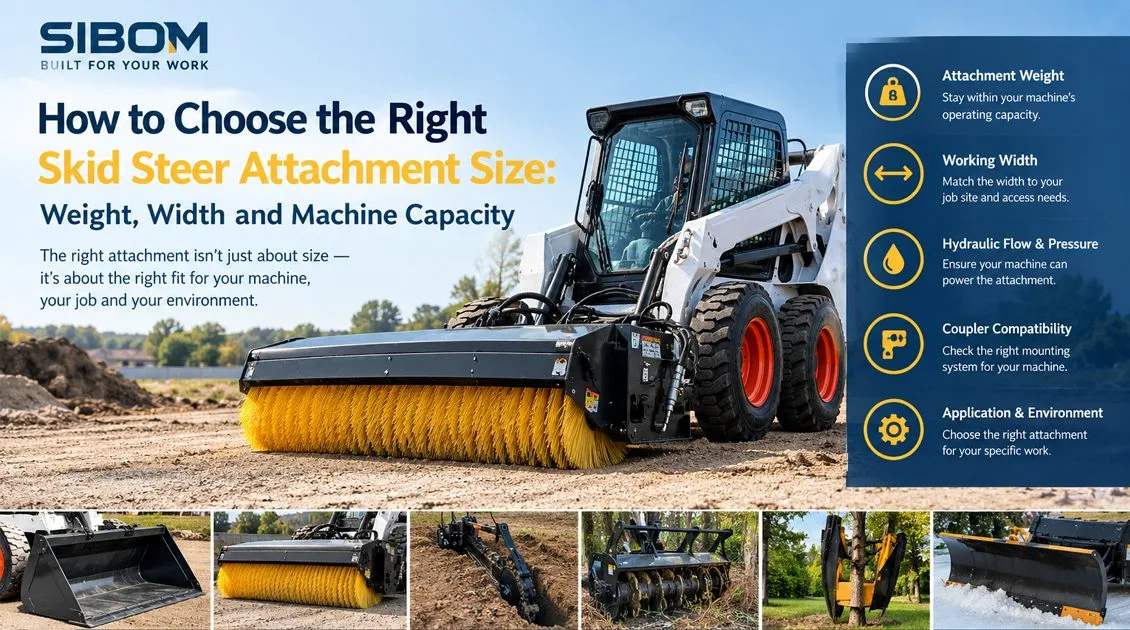
Choosing a skid steer attachment is not simply a matter of finding the widest bucket, broom, mulcher or other tool that will physically connect to the machine.
For Australian contractors, the more important question is whether the attachment is correctly matched to the carrier's operating capacity, hydraulic system, attachment weight, working width and actual job requirements.
An attachment that is too large can reduce stability, visibility and productivity. One that is too small may leave the machine underutilised and increase the number of passes required. The right choice sits between those two extremes.
Sibom supplies skid steer and compact track loader attachments for construction, landscaping, municipal maintenance, agriculture and other Australian applications. Its range includes buckets, grapples, brooms, trenchers, forestry attachments, tree spades, snow equipment and other specialised tools.
This guide explains how Australian buyers can evaluate attachment size before requesting a quotation.
Why Attachment Size Matters More Than Width Alone
Attachment width is one of the easiest specifications to compare, but it is rarely the most important one.
A wider attachment can cover more ground per pass, but it also normally increases the physical envelope of the machine and may increase attachment weight. On a compact skid steer working around buildings, fences, kerbs or landscaped areas, excessive width can become a disadvantage.
The same principle applies to powered attachments.
A forestry mulcher, for example, must be considered as a complete machine-and-attachment system. Hydraulic flow, pressure, attachment weight, carrier capacity and working width all affect whether the combination is practical.
A pickup broom has a different set of requirements because collection capacity and sweeping width become important. A trencher places more emphasis on hydraulic performance, digging depth and the type of ground being excavated.
The correct attachment therefore depends on the carrier + attachment + application, not on attachment dimensions alone.
Step 1: Start With the Skid Steer's Rated Operating Capacity
The first specification to check is the carrier's rated operating capacity and manufacturer guidance.
Do not begin by choosing an attachment and then assume the skid steer will handle it.
Instead, start with the machine.
Before requesting a quotation, record:
Machine make and model
Operating weight
Rated operating capacity
Auxiliary hydraulic flow
Auxiliary hydraulic pressure
High-flow or standard-flow configuration
Coupler type
Available attachment mounting system
Any manufacturer restrictions on attachment use
Sibom recommends providing the machine brand, model, operating weight, hydraulic flow and coupler type when checking attachment compatibility.
Why Operating Capacity Is Important
Attachment weight becomes part of the machine's working load.
A heavy attachment may reduce the practical lifting capacity available for the material being handled. It can also affect machine balance, forward tipping behaviour and transport considerations.
This becomes especially important when comparing attachments from different categories.
A snow blade may be relatively light compared with a forestry mulcher.
A pickup broom combines brush equipment with a collection bucket.
A trencher concentrates weight around the front of the machine and adds hydraulic power requirements.
A forestry mulcher is a substantially heavier powered attachment and normally requires a high-flow carrier.
A tree spade has different load and ground-engagement considerations because it is designed for digging and transplanting rather than continuous material handling.
The machine's capacity should therefore be checked before deciding on attachment width.
Step 2: Do Not Choose the Widest Attachment Automatically
A common purchasing mistake is assuming that a wider attachment is always more productive.
That is only true when the carrier can operate it effectively and the job actually benefits from the additional width.
Consider three different work environments.
Open Construction Site
On a large open construction site, a wider broom or blade can reduce the number of passes required.
The machine has room to manoeuvre, and the operator can take advantage of the additional coverage.
Residential Landscaping
A landscaping contractor working between fences, buildings, garden beds and driveways may benefit from a narrower attachment.
Manoeuvrability can be more valuable than maximum coverage.
Municipal Road or Car Park Work
A council or site-maintenance contractor may need enough working width to achieve efficient coverage while still reaching kerbs, narrow access points and confined areas.
In this situation, the correct width should be based on the typical operating environment, rather than the maximum available size.
Step 3: Match Attachment Weight to the Carrier
Attachment weight is particularly important when comparing powered and heavy-duty tools.
Sibom's current product range demonstrates why attachment categories cannot be treated as interchangeable.
For example, Sibom's forestry mulcher range includes multiple configurations with different working widths and attachment weights. The range also requires high hydraulic flow, making it a high-flow attachment class.
That means a contractor should not select the largest model simply because it offers the greatest cutting width.
The machine must be capable of handling:
The attachment's static weight.
The attachment's operating loads.
The hydraulic power requirement.
The working width.
The ground conditions.
The intended duty cycle.
A smaller machine with an oversized attachment can become less productive rather than more productive.
Step 4: Consider Working Width Together With Attachment Weight
Width and weight should be evaluated together.
A useful purchasing question is:
“How much additional productivity do I actually gain from the wider model, and what do I give up to get it?”
For example, Sibom's pickup broom range includes different working-width configurations. The published specifications also show that attachment weight and hydraulic requirements vary across the range.
This creates a practical trade-off.
A wider pickup broom can cover more surface in a single pass, but the machine must still have adequate attachment capacity and hydraulic capability.
For a large commercial hardstand, the wider configuration may make sense.
For a landscaping contractor cleaning narrow driveways, pathways or confined construction compounds, a smaller broom may be easier to control and transport.
Step 5: Match the Attachment to the Actual Job, Not the Machine's Maximum Capacity
Having a large skid steer does not mean every attachment should be purchased in its largest configuration.
The attachment should be selected according to the work being performed.
For Sweeping
Ask:
What surfaces will be cleaned?
How wide are the typical work areas?
Is debris being pushed or collected?
Are there kerbs and obstacles?
Is the machine operating in open areas or confined sites?
Sibom's pickup broom range is designed for sweeping and collection and is available in several working-width and hydraulic configurations.
For Trenching
Ask:
What trench depth is normally required?
What trench width is required?
Is side-shift useful?
What soil conditions are expected?
Is the work mainly irrigation, cable, drainage or another service?
Sibom currently offers different trencher configurations with different digging capabilities and hydraulic requirements.
For this type of work, selecting the deepest or largest model simply because the machine can carry it may not provide the best return.
For Forestry and Vegetation Work
Ask:
What type of vegetation will be processed?
How large is the material?
How frequently will the attachment operate?
Does the machine have the required high-flow circuit?
Is the objective mulching, mowing or tree relocation?
Sibom's forestry and landscaping range includes mulchers, tree spades, grass mowers and other vegetation tools, so the attachment should be selected according to the actual vegetation-management task.
A forestry mulcher is not a direct substitute for a grass mower, while a tree spade is intended to preserve and relocate trees rather than process vegetation.
Step 6: Hydraulic Flow Still Matters After You Check Weight
Attachment sizing cannot be separated from hydraulic requirements.
This is particularly important for powered attachments.
Sibom's existing guide on high-flow vs standard-flow skid steer attachments explains why hydraulic configuration needs to be considered before purchasing powered equipment.
High-flow tools such as forestry mulchers and cold planers can require substantially more continuous hydraulic flow than attachments such as buckets and forks.
Therefore, two attachments with similar physical dimensions can have completely different machine requirements.
Before ordering a powered attachment, confirm:
Auxiliary hydraulic flow
Hydraulic pressure
Continuous versus intermittent hydraulic use
Return circuit requirements
Case drain requirements where applicable
Hose and coupler configuration
Machine cooling capacity
Manufacturer-approved operating limits
Do not rely on the attachment name alone.
Step 7: Check the Coupler Before Finalising the Size
A physically large attachment is useless if its mounting system does not match the carrier.
Sibom's attachment coupler compatibility guide explains why compatibility requires more than checking whether the pins appear to be the same size.
Pin centres, pin diameter, lug dimensions, coupler geometry and locking engagement all need to be considered.
For Australian buyers, the enquiry should therefore include the exact:
Machine → Model → Coupler → Hydraulic Configuration
This is especially important when purchasing OEM or custom attachments.
Sibom supports attachment configurations for different machine requirements and can discuss custom mounting requirements where applicable.
Step 8: Consider Transport and Site Access
Attachment size also affects logistics.
Before purchasing a large attachment, consider:
Workshop storage space
Transport vehicle capacity
Trailer dimensions
Loading and unloading arrangements
Access through gates
Access between buildings
Working around fences and vegetation
Storage between seasonal jobs
This is particularly relevant for contractors who move attachments between multiple Australian job sites.
A tool that is highly productive on a large site may become inconvenient if it requires additional transport equipment or cannot easily access the majority of the contractor's regular jobs.
A Practical Attachment Sizing Framework
Australian contractors can use the following framework before requesting a quotation.
| Question | What to Check |
|---|---|
| What machine do I have? | Make, model and operating weight |
| How much can it safely handle? | Rated operating capacity and manufacturer guidance |
| What attachment am I considering? | Bucket, broom, trencher, mulcher, blade, tree spade or other attachment |
| How heavy is the attachment? | Published attachment weight |
| How wide should it be? | Typical working area and access restrictions |
| What hydraulic system is available? | Flow, pressure and high-flow/standard-flow configuration |
| What coupler do I have? | Universal, manufacturer-specific or custom |
| What is the actual application? | Construction, landscaping, agriculture, municipal or forestry |
| How often will it work? | Occasional, daily or continuous production |
| What happens after purchase? | Parts, maintenance, support and future compatibility |
The goal is not to select the biggest attachment.
The goal is to select the largest practical attachment that the machine can safely and effectively operate for the intended work.
Common Attachment Sizing Mistakes
Choosing by Width Only
Width is visible and easy to compare, but it does not tell you whether the carrier can safely and efficiently operate the attachment.
Ignoring Attachment Weight
A machine may physically connect to an attachment while still being an unsuitable carrier for the complete working combination.
Assuming Every Hydraulic Attachment Is Standard-Flow
Powered attachments vary considerably in hydraulic demand. High-flow requirements should be confirmed before purchase.
Buying for the Largest Possible Job
If most of your work involves narrow residential access, purchasing the widest attachment available may reduce manoeuvrability and increase transport difficulties.
Using Visual Coupler Matching
Two attachments may look compatible while having different mounting dimensions or locking geometry.
Failing to Provide Machine Information to the Supplier
A supplier cannot reliably confirm fitment from “Bobcat” or “medium-size skid steer” alone.
Providing the exact machine model, coupler and hydraulic information makes the quotation process much more accurate.
When a Custom Attachment Makes More Sense
Standard attachments are suitable for many applications, but not every Australian contractor operates standard machines or standard work sites.
Customisation can become useful when you require:
A non-standard mounting interface
A specific working width
Different hydraulic configuration
Modified dimensions
A particular material specification
Private-label production
Fleet-standardised attachment designs
Sibom supports OEM and custom manufacturing requirements through its engineering and manufacturing capabilities.
For dealers and fleet operators, this can also be useful when several machines need attachments built around a consistent specification.
What to Send Sibom When Requesting a Quote
A detailed enquiry does not need to be complicated.
Provide:
Machine: make and model
Carrier type: skid steer or compact track loader
Operating weight: manufacturer specification
Rated operating capacity: manufacturer specification
Hydraulic flow: GPM or L/min
Hydraulic pressure: manufacturer specification
Coupler: exact type
Application: what the attachment will actually do
Preferred working width: if known
Typical working environment: open site, residential, farm, road, council, forestry etc.
If you do not know the exact attachment size, that is not necessarily a problem.
Sibom can use the machine and application information to discuss an appropriate configuration before the order is finalised.
FAQ
What is the most important factor when choosing a skid steer attachment size?
There is no single specification that determines the correct size. Start with the carrier's rated operating capacity, then check attachment weight, hydraulic requirements, coupler compatibility, working width and application.
Should I always buy the widest skid steer attachment available?
No. Wider attachments can increase productivity in open areas, but narrower tools may be more effective around buildings, fences, landscaping features and confined work sites.
Does attachment weight affect skid steer performance?
Yes. Attachment weight affects the machine's available lifting capacity, balance and handling characteristics. Always follow the carrier manufacturer's operating limits.
Does a larger attachment always require high-flow hydraulics?
No. Hydraulic requirements depend on the attachment design. Some attachments have little or no continuous hydraulic demand, while powered tools such as forestry mulchers and cold planers can require high-flow systems.
How do I know if a Sibom attachment will fit my skid steer?
Provide the machine make, model, operating weight, coupler type and hydraulic specifications. Sibom can check the mechanical and hydraulic requirements before you order.
Is a compact attachment better for smaller Australian contractors?
Not necessarily. The correct choice depends on the carrier and application. A smaller attachment can improve manoeuvrability, while a larger attachment may increase productivity when the machine and job site can support it.
Can Sibom manufacture a custom attachment?
Sibom supports OEM and custom attachment requirements, including non-standard specifications. Contact the Sibom team to discuss your machine, application and manufacturing requirements.
Final Takeaway
Choosing the right skid steer attachment size is a machine-matching exercise, not simply a width comparison.
Australian contractors should evaluate the complete combination of carrier capacity, attachment weight, hydraulic flow, hydraulic pressure, coupler compatibility, working width and job requirements before purchasing.
The right attachment is the one that allows the skid steer to work efficiently without exceeding its operating limitations.
For contractors comparing brooms, trenchers, forestry attachments, snow equipment, buckets or other tools, the best starting point is to define the work first and then match the attachment to the machine.
If you already know your skid steer model but are unsure which attachment size or configuration is appropriate, provide Sibom with your machine specifications and intended application.
Contact Sibom to discuss compatibility, attachment requirements and available configurations before requesting a quotation.
Related Resources: