


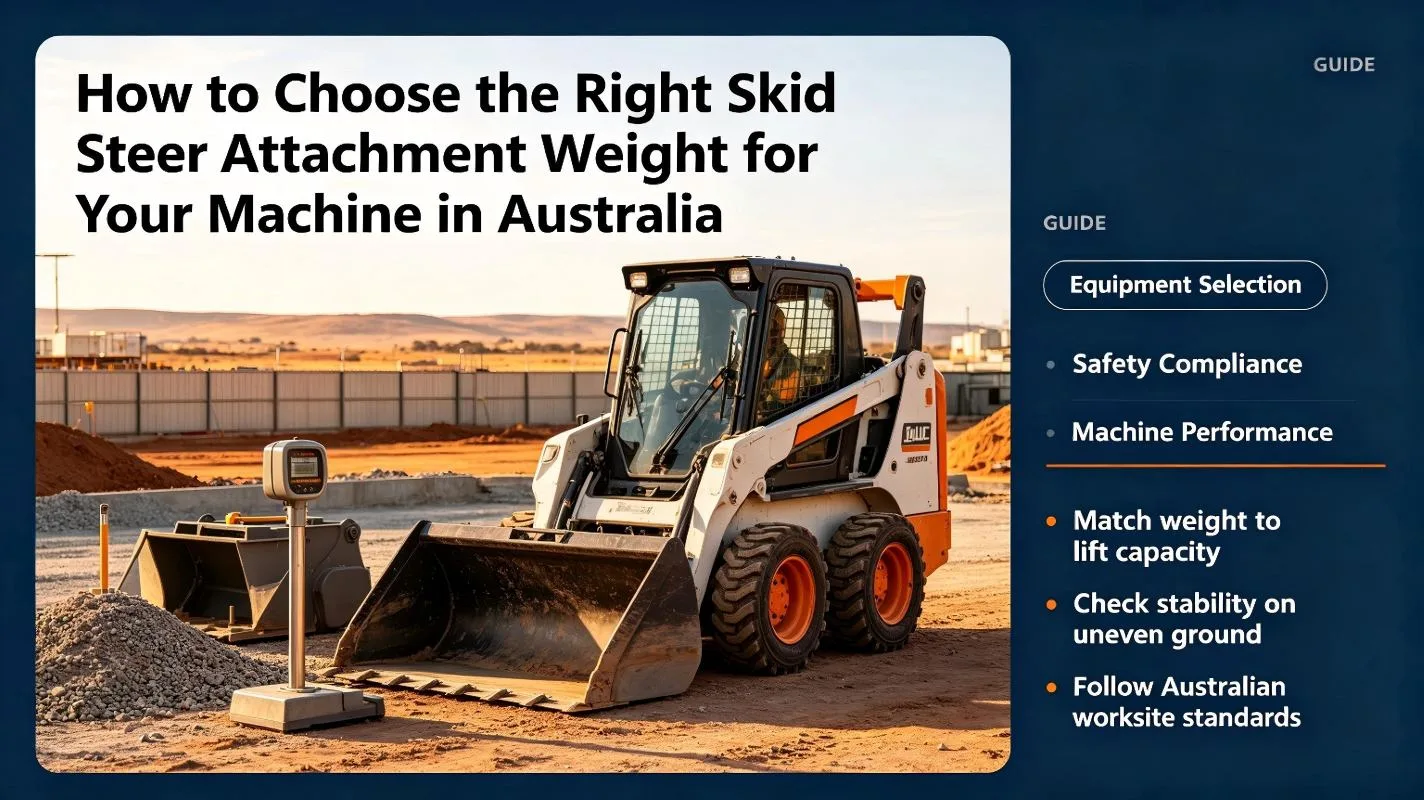
When Australian contractors compare skid steer attachments, hydraulic flow and working width are often near the top of the specification sheet. Weight is sometimes treated as a secondary consideration.
That can be a costly mistake.
An attachment does not operate in isolation. Its weight becomes part of the machine's working load, while the position of that weight in front of the loader affects leverage, stability and available lifting capacity. Adding a quick coupler can increase the effective front-end load again.
This becomes especially important when moving from relatively light attachments such as smaller brooms or trenchers to heavier tools such as forestry mulchers and cold planers.
The correct question is therefore not:
“Can my skid steer physically lift this attachment?”
It is:
“Is this attachment appropriately matched to my machine's rated operating capacity, hydraulic system, coupler, working geometry and actual application?”
For Australian contractors, farmers, landscapers, councils, civil contractors and equipment dealers, this distinction can prevent an attachment purchase that looks suitable on paper but performs poorly or reduces the machine's practical operating margin.
Attachment Weight Is Only One Part of the Equation
A common buying mistake is to compare the attachment's listed weight with the machine's rated operating capacity and assume that the numbers can simply be matched.
They cannot.
The attachment weight is only the starting point. The real operating situation can also include:
The weight of the quick coupler or mounting system
Material carried by the attachment
Load position relative to the loader arms
Lift height
Machine configuration
Counterweight or ballast
Tyre or track configuration
Ground conditions
Hydraulic requirements
The direction and type of working force
The manufacturer's rated operating capacity and stability limits
For example, a pickup broom with an integrated collection bucket may become significantly heavier once debris has been collected. A bucket or grapple also changes its effective load as material is added.
A forestry mulcher is different again. The attachment may not carry a large payload, but its considerable dead weight is positioned at the front of the machine while the carrier is working on uneven ground or slopes.
This is why attachment selection should always begin with the machine's actual specifications rather than the attachment brochure alone.
What Is Rated Operating Capacity?
Rated operating capacity, commonly referred to as ROC in skid steer specifications, is a key reference point when evaluating attachment compatibility.
It should not be treated as a simple “maximum attachment weight” figure.
ROC relates to the machine's ability to safely handle a load under defined operating conditions. The actual limit depends on the machine manufacturer's specification and operating configuration.
For an attachment buyer, the practical lesson is simple:
Do not use ROC as a standalone attachment-weight calculator.
Instead, use the machine manufacturer's operating information to establish whether the complete attachment and load combination is appropriate.
When requesting a quote from an attachment supplier, provide the machine make, model and operating capacity rather than only saying that you own a “medium skid steer”.
This gives the supplier a much better basis for recommending an attachment configuration.
Sibom asks customers to provide equipment brand, model and operating capacity when making an enquiry, together with coupler information and other application details.
Contact Sibom / Request a Quote
Attachment Weight vs Working Width
One of the most common purchasing decisions is choosing between a narrower and wider attachment.
Wider is not automatically better.
A wider attachment can increase productivity by covering more ground per pass, but it can also increase attachment weight, change the load position and require a larger carrier.
Sibom's pickup broom range provides a useful real-world example.
| Model | Working Width | Approx. Weight |
|---|---|---|
| SPB45 | 39 in | 396.8 lb |
| SPB60 | 60.2 in | 1,005.3 lb |
| SPB72 | 72 in | 1,058.2 lb |
| SPB84 | 83.9 in | 1,190.5 lb |
These figures demonstrate why working width should be selected according to the carrier and application rather than simply choosing the largest available model.
A contractor cleaning narrow accessways, residential developments or confined commercial areas may gain little from selecting the widest broom.
A contractor maintaining large industrial yards or open hardstands may benefit from greater coverage.
The right choice is the one that gives the required productivity without pushing the machine beyond its appropriate operating range.
Skid Steer Pick-Up Broom with Bucket
The Same Principle Applies to Trenchers
Sibom's skid steer trencher range provides another useful example.
The SDT24S is listed at approximately 727.5 lb, while the larger SDT36S is approximately 937 lb.
The two models also provide different digging depths, with the SDT24S designed around a shallower trench and the SDT36S providing greater digging depth.
This illustrates an important purchasing principle:
Choose attachment capability according to the work you actually quote.
If most jobs involve shallow irrigation, garden services or short utility trenches, a larger and heavier trencher may provide little additional commercial value.
If deeper service trenches are a regular requirement, the additional capability may justify the larger configuration.
The goal is not to minimise attachment weight at all costs. The goal is to avoid paying for unnecessary capacity while keeping the complete machine-and-attachment combination properly matched.
Skid Steer Trencher Attachment
Heavy Attachments Require a Different Machine-Selection Strategy
Some Sibom attachments are substantially heavier than general-purpose site tools.
The 0513 Series forestry mulcher, for example, is listed at approximately 2,172–2,721 lb depending on configuration and is designed for high-flow skid steer applications. Sibom also specifies a host lifting capacity requirement and recommends confirming the carrier's rated capacity before ordering.
The 0206 Series cold planer is another example, with listed attachment weights of approximately 1,874–2,535 lb depending on model. It also requires a high-flow skid steer and has model-dependent hydraulic requirements.
These attachments should not be selected using the same criteria as a small broom or light-duty bucket.
For heavier attachments, the buyer should review the entire combination:
Attachment weight
Machine rated operating capacity
Coupler and mounting weight
Hydraulic flow
Hydraulic pressure
Attachment centre of gravity
Working depth or cutting force
Ground conditions
Machine stability
Continuous operating duty
This is particularly important for forestry, road construction and land-clearing applications where the attachment can impose continuous loads on the carrier.
Why Coupler Weight Should Be Included
A quick coupler makes attachment changes faster, but it also adds weight to the front of the machine.
That additional weight needs to be considered when evaluating attachment combinations.
For example, a contractor may calculate:
Attachment weight = 1,000 lb
and assume the machine can comfortably handle it.
But the actual front-end combination could include:
Attachment + coupler + payload
The machine therefore sees a greater working load than the attachment specification alone suggests.
Sibom's compatibility guidance highlights that coupler weight can reduce available lifting capacity and that the machine should be evaluated with the coupler installed.
Attachment Coupler Compatibility Guide
Do Not Confuse Attachment Weight With Payload Capacity
This distinction is especially important for buckets, pickup brooms, grapples and material-handling attachments.
Consider a pickup broom.
The attachment itself has a published weight. But when the integrated collection bucket is filled with dirt, gravel or other debris, the machine is handling both the attachment and the collected material.
Sibom's pickup broom includes an integrated collection bucket, with the published range including different bucket capacities depending on model.
The practical implication is:
An attachment that is acceptable when empty may have a very different operating load when full.
The same principle applies to:
General-purpose buckets
4-in-1 buckets
Grapples
Material-handling attachments
Bale handling tools
Pallet forks
Pickup sweepers
Always evaluate the attachment in the condition in which it will actually be used.
Working Height Changes the Load
Another factor often overlooked during attachment selection is lift height.
A load positioned close to the machine behaves differently from the same load positioned farther forward and higher.
As the attachment and payload move away from the machine, the leverage acting on the loader increases.
This is why a contractor should not assume that an attachment is suitable simply because its empty weight appears comfortably below the machine's rated operating capacity.
The machine manufacturer's load charts and operating instructions should take priority.
For applications involving high lift, heavy material or frequent loading cycles, buyers should provide the supplier with information about the actual lifting task.
Loading trucks
Moving aggregate
Handling pallets
Loading green waste
Moving logs
Stockpile management
These are very different operating cycles even when the same loader is used.
How Australian Working Conditions Affect Attachment Selection
Australia presents a wide range of operating environments.
A landscaping contractor working on residential properties has very different requirements from a civil contractor clearing a rural subdivision or a council maintaining roads.
Residential Landscaping
Manoeuvrability and low surface disturbance may be more important than maximum attachment capacity.
Smaller attachments can provide better visibility and easier access around fences, gardens and buildings.
Agriculture
Farmers may value versatility because the same compact loader can be used for material handling, vegetation management, drainage and property maintenance.
The attachment should therefore be sized around the machine and the majority of the farm's actual jobs.
Civil Construction
Civil contractors often need attachments that can work continuously and withstand demanding ground conditions.
Hydraulic requirements, attachment weight, wear resistance and serviceability become increasingly important.
Municipal Work
Councils and municipal contractors may prioritise fleet versatility.
A machine that can operate several attachments within its approved operating range can provide greater utilisation across cleaning, vegetation, maintenance and material-handling tasks.
Forestry and Land Clearing
Forestry mulchers and heavy vegetation attachments require particular attention to hydraulic capacity, attachment mass, cooling and carrier stability.
Sibom's forestry mulcher range is positioned for high-flow land-clearing applications and lists attachment weights significantly above those of lighter general-purpose tools.
A Practical Attachment Weight Selection Process
Step 1: Identify the Machine
Record:
Manufacturer
Model
Serial number where available
Rated operating capacity
Operating weight
Auxiliary hydraulic flow
Hydraulic pressure
Coupler type
Do not rely only on the machine's model name because optional hydraulic configurations and machine specifications can vary.
Step 2: Define the Application
Explain what the attachment will actually do.
Road sweeping
Construction cleanup
Irrigation trenching
Asphalt repair
Forestry clearing
Farm vegetation management
Material handling
Loading aggregate
The supplier can then evaluate the attachment based on its real duty cycle.
Step 3: Determine the Required Attachment Capability
Ask what capability is genuinely required.
For a broom, this could be working width and collection capacity.
For a trencher, it could be trench depth.
For a cold planer, it could be milling width and cutting depth.
For a forestry mulcher, it could be vegetation density and working width.
Step 4: Check Attachment Weight
Compare the published attachment weight with the machine manufacturer's operating limits.
Do not stop at the empty attachment weight.
Consider the coupler, payload and operating geometry.
Step 5: Check Hydraulics Separately
Mechanical fit and weight compatibility do not guarantee hydraulic compatibility.
Confirm:
Flow
Pressure
Return requirements
Case drain requirements
Hose configuration
Electrical requirements where applicable
Sibom's current product range includes both standard-flow and high-flow attachments, so the hydraulic specification needs to be checked against the selected model rather than assumed from the attachment category.
High-Flow vs Standard-Flow Skid Steer Attachments
Step 6: Ask for Fitment Confirmation
Provide the supplier with complete machine information before paying a deposit or arranging freight.
This is especially important for custom couplers, older machines, non-standard configurations and larger attachments.
Attachment Size Should Follow the Job, Not the Brochure
The largest attachment is not necessarily the most productive attachment.
Consider a contractor who primarily performs small commercial landscaping jobs.
A very large attachment may:
Reduce manoeuvrability
Increase machine loading
Require higher hydraulic output
Increase transport considerations
Reduce the number of compatible carriers
Provide more capacity than the job requires
On the other hand, a contractor performing large-scale land clearing may find that a smaller attachment creates more passes and reduces hourly production.
The correct size therefore depends on the relationship between:
Machine capacity + attachment capability + application demand + operating environment.
That is the foundation of a good attachment purchase decision.
When a Custom Attachment May Make More Sense
Standard attachment models are suitable for many applications, but some fleets have requirements that do not fit a catalogue configuration.
Examples include:
Non-standard couplers
Specific working widths
Different mounting dimensions
Private-label requirements
Fleet-specific configurations
Special material requirements
Application-specific hydraulic arrangements
Sibom provides OEM and custom attachment manufacturing for dealers, equipment brands and customers requiring non-standard configurations.
For a custom request, provide the machine specifications and application requirements first. The attachment should be designed around the carrier rather than modified in the field after delivery.
Ask Sibom About OEM & Custom Attachments
Australian Skid Steer Attachment Buying Checklist
Machine make and model
Machine rated operating capacity
Operating weight
Auxiliary hydraulic flow
Hydraulic pressure
Coupler type
Coupler manufacturer and model where applicable
Attachment operating weight
Required working width
Required working depth or capacity
Expected payload
Typical ground or surface conditions
Daily operating hours
Continuous versus intermittent hydraulic duty
Transport requirements
Replacement wear parts
Maintenance access
OEM/custom requirements if applicable
If several items are unknown, do not guess. Ask the supplier to confirm the specification before the order is finalised.
Frequently Asked Questions
How do I know what weight attachment my skid steer can handle?
Start with the skid steer manufacturer's rated operating capacity and operating instructions. Then evaluate the complete combination of attachment, coupler, payload and operating conditions. Do not treat ROC as a simple maximum attachment-weight figure.
Is a heavier skid steer attachment always better?
No. A heavier attachment may provide greater capability or durability for demanding applications, but it can also reduce machine flexibility and available operating capacity. Select the attachment according to the work requirement.
Does a wider attachment need a larger skid steer?
Not automatically, but wider attachments often weigh more and can impose greater hydraulic or structural requirements. Check the specific attachment's weight, hydraulic requirements and the carrier manufacturer's limits.
Should I include coupler weight when choosing an attachment?
Yes. The coupler forms part of the machine-and-attachment combination and adds front-end weight. Its effect should be considered when evaluating lifting capacity and stability.
Does attachment weight matter if the attachment does not carry material?
Yes. The attachment's own weight still affects the loader. Heavy motorised attachments such as forestry mulchers and cold planers can place substantial load on the carrier even when they are not carrying a separate payload.
What information should I send Sibom for an attachment recommendation?
Provide your machine brand and model, rated operating capacity, hydraulic flow and pressure, coupler type, intended application and any specific working-width or capacity requirements. Photos of the coupler and hydraulic connections can also help confirm compatibility.
Can a smaller skid steer run a heavy attachment if the hydraulic flow is sufficient?
Not necessarily. Hydraulic compatibility is only one part of the selection process. Attachment weight, machine capacity, stability, mounting system and operating conditions must also be checked.
Should I choose the largest attachment my machine can technically carry?
Usually no. Choose the attachment that provides the required productivity while maintaining an appropriate operating margin and matching the real job conditions.
Can Sibom provide custom attachment configurations?
Yes. Sibom supports OEM and custom attachment manufacturing. Customers should provide carrier specifications, coupler information and application requirements so the attachment can be configured correctly.
Final Takeaway: Match the Whole Machine-and-Attachment Combination
Choosing a skid steer attachment in Australia should never be reduced to one number.
Hydraulic flow matters.
Coupler compatibility matters.
Working width matters.
Attachment weight matters.
But the most important factor is how all of these specifications work together on the actual machine and job.
A relatively light pickup broom may be ideal for routine construction clean-up, while a heavier trencher may be justified for repetitive utility work. A forestry mulcher or cold planer demands a much more careful review of carrier capacity, hydraulics and operating conditions.
The best buying decision is therefore not to select the biggest attachment or the lowest-weight attachment.
It is to select the right attachment for the machine, the work and the operating environment.
For Australian contractors, farmers, landscaping businesses, councils, equipment dealers and fleet managers, providing complete machine information before ordering is one of the simplest ways to reduce compatibility problems and improve attachment utilisation.
If you are unsure which Sibom attachment configuration matches your machine, provide the machine model, rated operating capacity, hydraulic flow, pressure, coupler type and intended application. Sibom can review the requirements and confirm the appropriate configuration before you proceed with a quote.
Request a Quote for your machine and application before ordering.