


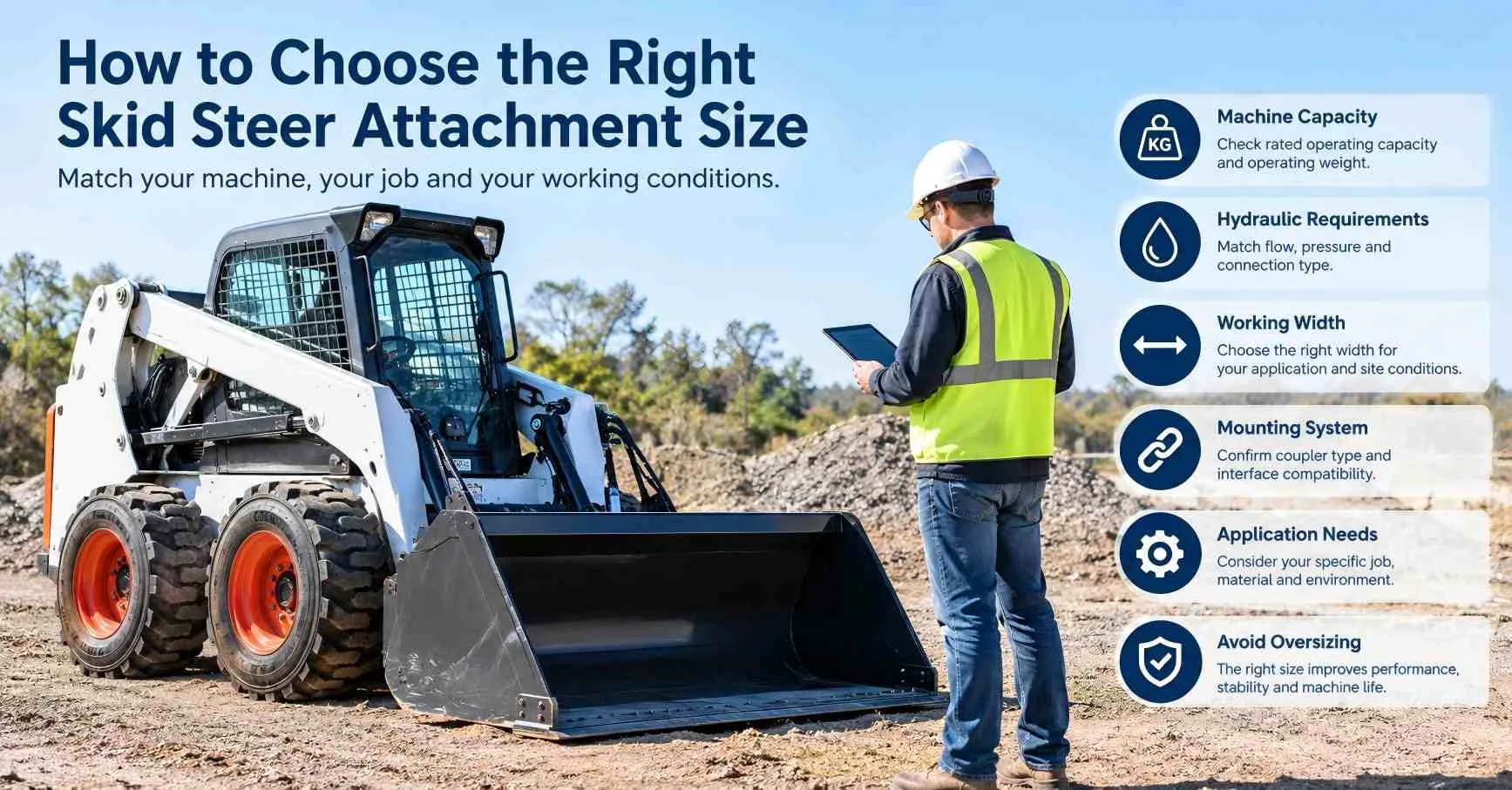
Choosing a skid steer attachment is not simply about selecting the widest or largest model. The attachment must match the carrier's lifting capacity, hydraulic system, mounting interface and the actual working conditions.
For Australian contractors, landscapers, farmers, councils and equipment dealers, getting the size right before ordering can help avoid poor performance, unnecessary wear and compatibility problems.
1. Start With the Machine
Before comparing attachments, identify the exact skid steer or compact track loader.
Machine make and model
Rated operating capacity
Operating weight
Auxiliary hydraulic flow and pressure
Quick-attach or coupler type
Available hydraulic connections
When requesting attachment compatibility confirmation, provide the machine brand and model together with the relevant hydraulic and coupler information.
2. Attachment Weight Matters
A heavy attachment reduces the effective lifting capacity of the machine. This becomes particularly important with larger hydraulic attachments and other powered tools.
Do not compare attachment weight alone. Consider the complete operating combination:
Attachment weight + payload/material + load position
The complete combination should remain within the machine manufacturer's operating limits.
3. Match Hydraulic Requirements
Hydraulic flow is critical for powered attachments. A standard-flow attachment should not automatically be connected to a high-flow circuit at maximum output. Likewise, a high-flow attachment may perform poorly if the carrier cannot provide sufficient flow.
Before ordering, confirm:
Required hydraulic flow
Maximum hydraulic pressure
Return-line requirements
Case drain requirements where applicable
Hydraulic coupler type
The hydraulic requirements should be checked against the individual attachment specification and the auxiliary hydraulic system of the carrier.
4. Choose Working Width Based on the Job
A wider attachment is not always more productive. Working width should be selected according to the site, access conditions and type of work.
| Application | Key Consideration |
|---|---|
| Large open hardstand | A wider attachment can reduce the number of passes. |
| Narrow residential site | A smaller working width can improve manoeuvrability. |
| Road maintenance | Match the working width to the required operating area. |
| Landscaping | Consider access between buildings, fences and other obstacles. |
| Farm work | Match the attachment width to access tracks and working areas. |
5. Consider the Mounting System
Hydraulic compatibility does not guarantee mechanical compatibility.
Before purchasing, confirm:
Quick-attach or coupler type
Coupler manufacturer and model where relevant
Attachment interface dimensions
Hydraulic hose connections
Pin dimensions where applicable
Providing accurate machine and coupler information before ordering helps reduce the risk of purchasing an attachment that cannot be correctly installed on the carrier.
6. Match the Attachment to the Actual Work
The best attachment is usually the one that can be used efficiently for the work your machine performs most often.
Construction
Construction contractors may require buckets, trenching equipment, sweepers and other attachments depending on the project.
Landscaping
Landscaping contractors can use grading tools, buckets, sweepers and vegetation-management attachments across different stages of a project.
Agriculture
Farm operators may benefit from attachments such as buckets, forks, grapples and vegetation-management equipment for different seasonal tasks.
Municipal Maintenance
Municipal operators can use sweepers, brooms, blades and other maintenance attachments for roads, paths and public areas.
7. Do Not Oversize the Attachment
An oversized attachment can reduce productivity rather than increase it.
Reduced lifting capacity
Poorer machine stability
Higher hydraulic load
More difficult manoeuvring
Increased tyre or track wear
Greater transport requirements
The right attachment is the one that provides sufficient working capacity without pushing the carrier beyond its practical operating limits.
Quick Buyer Checklist
Before requesting a quote, prepare the following information:
Machine make and model
Rated operating capacity
Auxiliary hydraulic flow
Hydraulic pressure
Coupler type
Preferred attachment width
Main application
Typical material or working conditions
Expected operating frequency
Providing this information allows the supplier to recommend a configuration based on the actual job rather than simply the attachment name.
Frequently Asked Questions
Should I always choose the largest skid steer attachment?
No. Attachment size should be matched to machine capacity, hydraulic requirements, access conditions and workload.
Does attachment weight affect skid steer lifting capacity?
Yes. Attachment weight forms part of the total load carried by the machine and should be considered together with payload and load position.
Can one attachment fit different skid steer models?
Sometimes. Compatibility depends on the mounting interface, hydraulic requirements and machine capacity. Fitment should always be confirmed rather than assumed.
Is a wider attachment always faster?
Not necessarily. A wider tool may reduce passes in open areas but can be harder to manoeuvre in restricted spaces.
What information should I provide before ordering?
Provide the machine brand and model, coupler type, hydraulic flow and pressure, intended application and preferred attachment configuration. This information can be used to confirm compatibility and discuss suitable specifications.
Conclusion
Choosing the right skid steer attachment size requires more than comparing dimensions or purchase prices.
Australian buyers should consider machine capacity, attachment weight, hydraulic requirements, mounting compatibility, working width and actual job conditions together.
The best attachment is not necessarily the biggest one. It is the configuration that allows the machine and attachment to work efficiently as one system.
If you are unsure which attachment configuration is suitable for your skid steer or compact track loader, contact Sibom with your machine details and application requirements before ordering.