


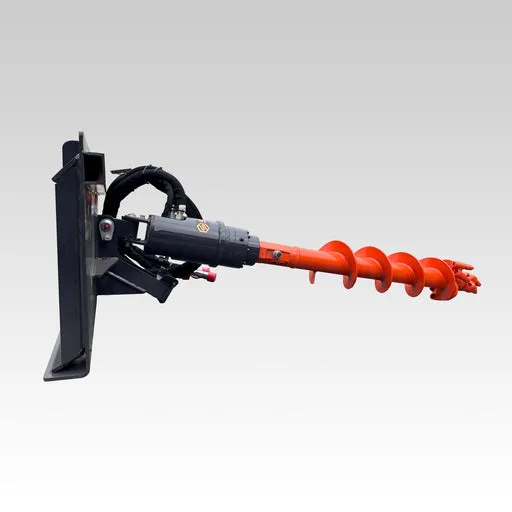
Few attachments earn their keep as quickly as a skid steer earth auger. Fence lines that once took a crew several days with a tractor post hole digger or hand-held auger can be drilled in an afternoon. Deck and carport piers go in straight and to depth. Revegetation crews can plant hundreds of trees a day without fighting baked clay with a shovel.
But an auger that is wrong for the carrier or the ground is just as quick to disappoint. A drive unit that is starved of hydraulic flow stalls in clay. A bit with soil teeth skates on sandstone. A heavy drive on a small machine eats into rated capacity and makes the loader nervous on a slope. This guide is written for Australian farmers, fencing contractors, builders, landscapers and councils who want to choose and run a skid steer auger properly — from bit size in millimetres to soil type, hydraulics and safe digging.
Quick Answer: Which Auger Setup Fits Your Job?
Start with the hole, not the attachment. Typical Australian applications fall into a few clear groups:
| Job | Typical hole diameter | Typical depth | Suggested Sibom drive |
|---|---|---|---|
| Timber fence posts, tubestock planting | 150–250 mm | 0.6–0.9 m | SAHG25 or SAHG45 |
| Strainer and gate posts, stock yards | 250–350 mm | 0.9–1.2 m | SAHG45 |
| Deck, pergola and carport piers, signage | 300–450 mm | To engineer’s design | SAHG75 |
| Larger piers, advanced tree planting, bollards | 450–700 mm | 1.2–3.0 m | SAHG100 |
| Large footings and deep bored piers | Up to 1,000 mm | Up to 5 m+ | SAHG200 (larger carriers) |
Hole sizes above are typical starting points only. Footings for structures must follow the engineer’s drawings and local council requirements, and post depths for fencing depend on post height, soil and wind or stock loads.
How a Skid Steer Earth Auger Works
An earth auger attachment has three main parts: a mounting frame that locks onto the skid steer quick hitch, a hydraulic drive unit that turns the bit, and the auger bit itself — a steel shaft with spiral flights, cutting teeth and a pilot point.
The drive unit is powered by the loader’s auxiliary hydraulics. Sibom’s drives use a direct-drive planetary gearbox, which multiplies the hydraulic motor’s torque and keeps power delivery smooth when the bit hits roots or compacted layers. The drive is reversible, so the operator can back the bit out of a jammed hole or spin soil off the flights. A locking collar limits unwanted swinging during transport and positioning, helping the bit start on the mark and drill straight. Each unit ships with hoses and flat-face couplers so it can be connected cleanly to most loaders.
Because the bit hangs freely from the frame, gravity helps keep holes plumb. The operator controls down-pressure with the loader arms and tilt, letting the auger pull itself into the ground rather than forcing it.
Sibom Earth Auger Drive Range (Metric Specifications)
The Sibom skid steer earth auger is available in five drive sizes. Figures below are converted to metric for Australian buyers:
| Model | Weight | Oil flow | Pressure | Bit diameter | Speed (rpm) | Listed max depth |
|---|---|---|---|---|---|---|
| SAHG25 | approx. 148 kg | approx. 23 L/min | approx. 170 bar | 50–300 mm | 42–152 | approx. 1.6 m |
| SAHG45 | approx. 187 kg | approx. 23 L/min | approx. 155 bar | 100–400 mm | 20–73 | approx. 2.1 m |
| SAHG75 | approx. 249 kg | approx. 45 L/min | approx. 186 bar | 100–500 mm | 31–107 | approx. 2.4 m |
| SAHG100 | approx. 297 kg | approx. 45 L/min | approx. 170 bar | 100–700 mm | 20–72 | approx. 3.0 m |
| SAHG200 | approx. 498 kg | approx. 45 L/min | approx. 186 bar | 100–1,000 mm | 11–37 | approx. 5.3 m |
Standard bits are about 1.2 m long on the SAHG25–SAHG75 and about 1.5 m on the SAHG100 and SAHG200. Listed maximum depths assume the right bit and extension combination, so confirm the full setup if you regularly drill beyond the bit length. Bit diameters run from 50 mm up to 1,000 mm, including common sizes such as 150, 200, 250, 300, 400, 500 and 600 mm.
Two patterns stand out. Smaller drives turn faster, which suits narrow fence and planting holes where speed matters. Larger drives turn slower with much more gear reduction, which is what you need to keep a 500–1,000 mm bit cutting without stalling.
Matching the Auger to Your Skid Steer’s Hydraulics
The good news for most Australian owners is that earth augers are not high-flow tools. Sibom’s drives are rated at roughly 23–45 L/min, which sits within the auxiliary output of most standard-flow skid steers and compact track loaders. If you are unsure what standard and high flow mean on your machine, read our guide to high-flow vs standard-flow skid steer attachments.
That said, “fits” and “performs well” are not the same. Check these points before ordering:
Flow and pressure: send your loader’s auxiliary flow (L/min) and relief pressure (bar). Too little flow means slow rotation; much more flow than the drive is rated for can overspeed the motor, so the supplier may recommend a flow setting or restrictor.
Return line and case drain: confirm whether your carrier and the chosen drive need a case drain connection. Our article on case drains on skid steer attachments explains how to check.
Coupler fit: confirm quick-hitch style and coupler sizes so hoses connect without adaptors that restrict flow.
Weight and capacity: a loaded auger bit full of wet clay weighs far more than the empty drive. Check the combination against your loader’s rated operating capacity — see matching attachment weight to rated capacity.
Lift height: with a bit fitted, overall height ranges from about 1.85 m (SAHG25) to about 2.56 m (SAHG200). The loader must lift the drive high enough to clear the bit tip over the ground and over the spoil pile.
Australian Soil Conditions and Bit Selection
Australia’s soils punish augers in very different ways. Choosing the right teeth and pilot matters as much as choosing the right drive.
Reactive Clay
Common across Melbourne, Adelaide, western Sydney and much of inland Queensland. Clay drills easily when moist but sticks to the flights and can turn to near-concrete in a dry summer. Use standard earth teeth, drill in short stages and lift the bit regularly to clear spoil. In very dry clay, wetting the hole location the day before can make a large difference.
Coastal and Inland Sand
Perth, the Gold Coast and many coastal developments sit on sand. Sand drills fast, but holes can collapse and the bit may not lift spoil cleanly. A slower rotation, a good pilot and backfilling or setting posts promptly all help. For piers, follow the engineer’s requirements for casing or sleeves.
Sandstone, Shale and Rocky Ground
Sydney sandstone, Hunter Valley shale and rocky hill country quickly destroy standard soil teeth. Specify rock teeth (tungsten carbide tips) and a rock pilot. Expect slower progress, use steady down-pressure rather than hammering the bit, and inspect teeth after every few holes.
Black Soil and Mixed Ground
Black cracking clays on the Darling Downs, Liverpool Plains and other farming regions swell when wet and crack open when dry. Mixed ground with gravel lenses, roots and old fill is also common on rural blocks. A heavier drive with good gear reduction and a bit with replaceable teeth gives the most consistent results.
Common Earth Auger Applications in Australia
Farm and Rural Fencing
Fencing is the biggest single use for skid steer augers in Australia. Strainer assemblies, gate posts, corner posts and stock yard posts all need clean, consistent holes. A loader-mounted auger lets one operator drill a full fence line and then switch to a grapple or pallet forks to move posts and rolls of wire. See related tools in livestock and ranching attachments.
Construction Piers and Footings
Builders and concreters use augers for deck and pergola piers, carport and shed footings, retaining wall posts and signage foundations. Straight, accurately sized holes reduce concrete waste and speed up inspections. For other site tools, browse construction equipment.
Landscaping, Revegetation and Tree Planting
Landcare groups, councils and landscapers use augers to plant tubestock, windbreaks and advanced trees. A 150–250 mm bit handles tubestock quickly, while larger bits suit advanced stock. For moving established trees rather than planting new ones, pair the auger with a skid steer tree spade. More options are in forestry and landscaping attachments.
Solar, Vineyard and Infrastructure Work
Solar farm builders sometimes pre-drill pile locations in rocky ground before driving or setting piles. Vineyards and orchards use augers for trellis posts. Councils and utilities drill holes for bollards, guard rail posts, signage and light poles. In each case, consistent hole diameter and depth make the following installation step faster.
Before You Dig: Services and Site Safety
Every auger hole is an excavation. Before drilling anywhere in Australia, lodge a free request through Before You Dig Australia (BYDA) to find underground services such as power, gas, water, telecommunications and fuel lines. On private property, also ask the owner about unmapped private services such as irrigation lines, septic systems and power to sheds or pumps.
Basic safety rules for auger work:
Keep everyone well clear of the rotating bit. Entanglement with a rotating auger causes serious injuries.
Never clear spoil or remove roots from the flights while the drive is powered. Lower the bit, stop rotation and shut down hydraulics first.
Check for overhead power lines before raising the drive.
Cover or barricade open holes, especially near livestock, public areas and walkways.
Follow your state work health and safety requirements and the machine and attachment manuals.
Operating Tips for Straight, Clean Holes
Park square and level. Position the loader so the bit hangs vertically over the mark. Working across a slope makes holes lean.
Start slowly. Let the pilot bite at low speed before increasing rotation.
Let the auger do the work. Apply light, steady down-pressure. Pushing too hard stalls the drive and can lift the front of the loader.
Clear spoil often. Drill 300–500 mm, lift the bit while rotating to bring soil up, then continue. This matters most in clay.
Use reverse to free a jam. If the bit stops on a root or rock, reverse slightly and lift before trying again.
Mark depth. Paint or tape depth marks on the bit so every hole on a fence line ends up the same.
Maintenance That Extends Auger Life
Teeth and pilot: replace worn teeth before they wear into the tooth holders. Worn pilots make holes wander.
Hoses and couplers: inspect for abrasion where hoses pass the loader arms, and keep couplers capped and clean.
Grease and pins: grease the pivot points regularly and check the mounting frame for cracks after heavy rock work.
Gearbox oil: follow the manual for oil checks and change intervals on the planetary drive.
Bit flights: straighten or repair bent flights early. A damaged flight carries less spoil and loads the drive unevenly.
Buying Checklist for Australian Owners
Main hole diameters and depths you will drill in the first year
Dominant soil type: clay, sand, rock or mixed
Skid steer or CTL make and model, auxiliary flow (L/min) and pressure (bar)
Quick-hitch style and coupler sizes
Whether you need soil teeth, rock teeth or both
Bit extensions needed for deep piers
Delivery state or port, and lead time needed for your project
If you have not chosen a carrier yet, our comparison of wheeled skid steers and compact track loaders explains which platform suits soft paddocks versus firm building sites.
Why Australian Buyers Choose Sibom
Sibom Industry manufactures attachments in its own factory, with in-house design and OEM service for custom mounting plates, hydraulic interfaces and private labelling. The Sibom earth auger can be supplied as a drive-and-bit package matched to your loader and ground conditions, and it can be shipped alongside Sibom skid steer loaders and other attachments in one consignment.
Australian customers receive a 2-year warranty and direct support by phone on +61 421 696 999 or email at wenfengshen@sibom.com.au.
FAQ: Skid Steer Earth Augers in Australia
Do I need a high-flow skid steer to run an earth auger?
Usually not. Sibom auger drives are rated at roughly 23–45 L/min, which most standard-flow skid steers and compact track loaders can supply. Send your loader’s flow and pressure so the drive and any flow setting can be confirmed.
What size auger do I need for fence posts?
Most timber fence posts need a 150–250 mm hole, and strainer and gate posts usually need 250–350 mm. The SAHG25 or SAHG45 drive suits most rural fencing.
Can a skid steer auger drill through rock?
It can drill soft rock, shale and weathered sandstone when fitted with rock teeth and a rock pilot, but progress is slower. Solid hard rock may need a breaker or a specialist drilling rig.
How deep can a skid steer earth auger drill?
Standard bits are about 1.2–1.5 m long. Listed maximum depths range from about 1.6 m on the SAHG25 to about 5.3 m on the SAHG200, using the right bit and extension setup.
What information should I send for a quote?
Send your loader make and model, auxiliary flow and pressure, quick-hitch type, required hole diameters and depths, soil type and delivery location. That is enough to recommend a drive, bits and teeth that suit the job.
Ready to speed up your fencing, piers or planting? View the Sibom skid steer earth auger or contact the team with your machine and hole sizes for a matched quote.