


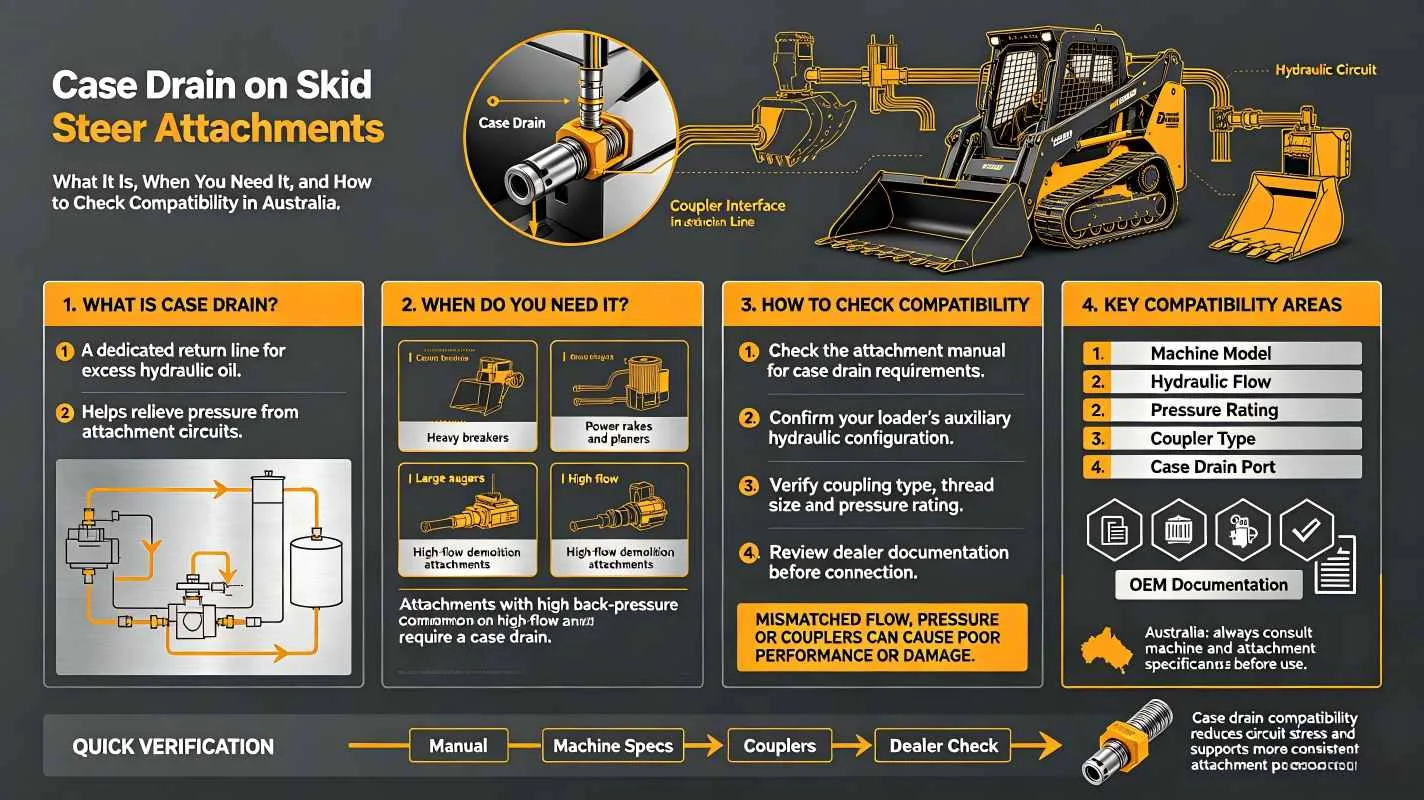
If you are buying a hydraulic skid steer attachment in Australia, checking auxiliary hydraulic flow and pressure is only part of the compatibility process.
There is another connection that is often overlooked: the case drain.
An attachment can have the correct quick-attach interface and appear to have suitable hydraulic flow, yet still be unsuitable for the carrier if its hydraulic motor requires a case drain that the machine cannot provide.
This matters particularly with motor-driven attachments such as certain brooms, mulchers, planers and other continuously powered hydraulic tools.
For Australian contractors, landscapers, farmers, councils, rental fleets and equipment dealers, understanding case-drain requirements before ordering can help prevent incorrect fitment, commissioning problems and avoidable downtime.
This guide explains what a case drain does, which attachments may require one, how it differs from the main hydraulic return line, and what information you should provide to Sibom before purchasing a hydraulic attachment.
What Is a Case Drain?
A case drain is a low-pressure hydraulic return line that allows internal leakage from a hydraulic motor or other hydraulic component to return safely to the hydraulic reservoir or designated return circuit.
Hydraulic motors are not perfectly sealed internally. A small amount of hydraulic oil can pass through internal clearances during normal operation. This oil needs somewhere to go.
The case-drain circuit provides that path.
The important point is that a case drain is not simply another auxiliary hydraulic supply hose.
A typical powered attachment may therefore have:
A pressure line supplying hydraulic oil to the motor
A return line carrying oil back from the motor
A case-drain line carrying internal leakage away from the motor housing
Additional hydraulic or electrical connections depending on the attachment design
The exact configuration depends on the attachment and hydraulic motor being used.
Sibom's current attachment guidance specifically recommends confirming return requirements and case-drain requirements before ordering, rather than assuming that two standard auxiliary hoses are sufficient.
Why Does a Hydraulic Motor Need a Case Drain?
The easiest way to understand a case drain is to think about pressure inside the hydraulic motor housing.
A hydraulic motor converts hydraulic energy into mechanical rotation. During operation, some oil inevitably passes through internal clearances as leakage.
If this leakage is allowed to build up inside the motor housing, internal pressure can increase beyond the level the motor's seals are designed to tolerate.
That can lead to problems such as:
Seal damage
Oil leakage
Premature motor wear
Excessive heat
Reduced motor reliability
Hydraulic motor failure
A correctly installed case-drain circuit gives this leakage oil a controlled path out of the motor housing.
For this reason, a case drain should be treated as a hydraulic compatibility requirement, not an optional accessory that can be ignored because the main pressure and return hoses connect successfully.
Case Drain vs Hydraulic Return: What Is the Difference?
This is one of the most important points for attachment buyers.
The main hydraulic return line carries the working oil leaving the hydraulic motor or hydraulic circuit.
The case drain carries internal leakage from the motor housing.
They perform different functions.
| Connection | Main Function | Typical Pressure Consideration |
|---|---|---|
| Pressure line | Supplies hydraulic oil to the attachment | High pressure |
| Main return | Returns working oil from the hydraulic motor/circuit | Controlled return pressure |
| Case drain | Removes internal motor leakage | Very low back pressure is often required |
| Electrical connection | Controls valves, sensors or other functions | Depends on attachment |
The exact hydraulic circuit must always be checked against the attachment manufacturer's requirements.
One of the common mistakes is to connect the case-drain hose to a return circuit simply because the physical connector appears to fit.
That is not a safe compatibility test.
The correct connection depends on the hydraulic motor, carrier and attachment configuration.
Which Skid Steer Attachments May Need a Case Drain?
Not every skid steer attachment needs a case drain.
Simple non-powered attachments such as buckets and pallet forks generally do not have a continuously rotating hydraulic motor and therefore do not have the same case-drain requirement.
Hydraulic cylinder-based attachments may also operate without a separate motor case drain, depending on their hydraulic design.
The issue becomes more important with attachments that use continuously powered hydraulic motors.
Examples can include:
Pick-up brooms
Rotary sweepers
Forestry mulchers
Cold planers
Certain augers
Hydraulic cutters
Hydraulic saws
Other motor-driven attachments
However, you should never determine case-drain requirements from the attachment category alone.
Two attachments that perform a similar job can use different hydraulic components or configurations.
Sibom's own published Pick-up Broom information, for example, specifically mentions a 3/8-inch case-drain line for newer skid steers that require it.
The practical rule is simple:
Check the technical specification for the exact attachment model and configuration before ordering.
A Real Sibom Example: Pick-Up Broom
Sibom's Skid Steer Pick-up Broom is a useful example of why case-drain compatibility should be checked before delivery.
The product is designed for sweeping and collecting debris from surfaces such as asphalt, concrete and paved areas. It uses a direct-drive hydraulic motor and is available in several working widths. The published product information also identifies a case-drain line for newer skid steers that require it.
This means the buyer should not only ask:
“Will this broom fit my skid steer?”
A better technical enquiry is:
What is my skid steer model?
What auxiliary hydraulic flow does it provide?
What hydraulic pressure is available?
Does the machine have the required return configuration?
Does the machine provide a case-drain connection?
What type of coupler is installed?
Does the selected broom configuration require a case drain?
Are the hydraulic connectors compatible?
Sibom recommends providing the machine brand, model and hydraulic information so attachment compatibility can be confirmed before ordering.
What Happens If a Case Drain Is Missing?
The answer depends on the attachment and hydraulic motor design, but forcing an attachment to operate without the required case-drain connection can create unnecessary risk.
A hydraulic motor designed to operate with a dedicated case drain relies on that circuit to control internal housing pressure.
If the case drain is blocked, incorrectly connected or subjected to excessive back pressure, internal motor pressure can increase.
Possible symptoms may include:
Hydraulic oil leakage around the motor
Premature seal failure
Excessive motor temperature
Reduced attachment performance
Unusual hydraulic noise
Repeated hydraulic motor problems
Unexpected attachment downtime
These symptoms can be mistaken for other hydraulic problems.
For example, an operator may assume that poor attachment performance is caused by insufficient hydraulic flow, when the actual issue is incorrect return plumbing or excessive back pressure.
This is why troubleshooting should begin with the complete hydraulic circuit rather than changing attachment settings at random.
Can I Add a Case Drain to My Skid Steer?
Sometimes a carrier can be configured to support an attachment that requires a case drain, but this should not be treated as a simple hose installation.
The correct solution depends on the machine's hydraulic architecture and manufacturer requirements.
Before modifying a skid steer, confirm:
Whether the machine manufacturer provides a dedicated case-drain connection.
Whether the auxiliary hydraulic package supports the attachment.
Whether the attachment requires a dedicated low-pressure return.
What connector and hose specification is required.
Whether the return path goes directly to tank or through another approved circuit.
Whether additional hydraulic cooling capacity is required for continuous operation.
Whether the modification affects the machine warranty or approved configuration.
If the machine does not have the required connection, discuss the situation with the attachment supplier and the machine manufacturer before making modifications.
Do not simply connect a case-drain hose to whichever port is available.
Case Drain Is Not the Same as High Flow
Another common misunderstanding is assuming that a high-flow skid steer automatically provides the correct hydraulic configuration for every high-flow attachment.
It does not.
Hydraulic compatibility involves several separate parameters:
Flow + Pressure + Return + Case Drain + Coupler + Machine Capacity
A carrier can have high auxiliary flow and still require additional confirmation for:
Case-drain availability
Maximum allowable return pressure
Hydraulic connector type
Electrical controls
Attachment operating weight
Cooling capacity
Coupler configuration
Sibom's existing hydraulic guidance makes the same broader point: hydraulic flow should be matched to the attachment's published operating range, while return and case-drain requirements must also be confirmed.
Case Drain and High-Flow Attachments
High-flow attachments often operate under sustained hydraulic load.
This is particularly relevant to applications such as:
Forestry clearing
Vegetation management
Road milling
Heavy sweeping
Continuous cutting
Large-scale landscaping
Sibom's forestry mulcher range, for example, is designed around high-flow hydraulic operation and continuous cutting work. Its published specifications identify hydraulic flow and pressure requirements that must be matched to the carrier.
However, high flow itself does not tell you whether a case drain is required.
The attachment's hydraulic motor specification remains the deciding reference.
For contractors working long shifts in Australian conditions, this distinction is particularly important because hydraulic heat and continuous duty cycles can expose a poorly matched system much faster than short intermittent operation.
How to Check Case-Drain Compatibility Before Buying
A practical compatibility check can be completed before the attachment is shipped.
Step 1: Identify the Exact Machine
Provide:
Manufacturer
Model
Serial number where available
Standard-flow or high-flow configuration
Machine operating capacity
Do not rely only on a machine family name.
Different configurations of the same model range can have different hydraulic specifications.
Step 2: Check Auxiliary Flow
Record the actual auxiliary hydraulic flow in L/min or GPM.
Do not assume that two machines with similar horsepower have the same hydraulic output.
Step 3: Check Auxiliary Pressure
Confirm the machine's available hydraulic pressure and compare it with the attachment's published requirement.
Flow and pressure are separate specifications.
Step 4: Identify the Hydraulic Ports
Before ordering, determine:
Pressure connection
Main return connection
Case-drain connection
Electrical connector where applicable
Photos of the machine's auxiliary hydraulic ports can also be useful during a compatibility review.
Step 5: Check the Attachment Specification
Ask the supplier:
Does this attachment require a case drain?
What case-drain connection is required?
What return configuration is required?
What is the maximum allowable return or case pressure?
Does the selected model differ from other configurations?
Do not assume that the requirements are identical across an entire product category.
Step 6: Confirm Mechanical Fitment
Hydraulic compatibility is only one part of the process.
Also confirm:
Quick-attach type
Coupler manufacturer and model
Mounting dimensions
Attachment weight
Machine rated operating capacity
Working width
Application requirements
Sibom's Australian skid steer attachment range specifically advises customers to provide their machine brand, model and coupler information for fitment confirmation.
A Practical Pre-Purchase Checklist for Australian Contractors
Before ordering a powered skid steer attachment, use this checklist:
| Check | What to Confirm |
|---|---|
| Machine | Exact make and model |
| Hydraulic flow | Actual L/min or GPM |
| Hydraulic pressure | Machine operating specification |
| Main return | Correct return circuit |
| Case drain | Required or not required |
| Case-drain pressure | Maximum permitted by attachment/motor |
| Coupler | Exact mounting interface |
| Attachment weight | Suitable for carrier capacity |
| Working width | Appropriate for the job |
| Duty cycle | Intermittent or continuous operation |
| Cooling | Suitable for the expected hydraulic load |
| Application | Actual material, terrain and operating conditions |
This checklist is particularly useful for contractors purchasing attachments remotely or arranging equipment transport between Australian states.
Common Case-Drain Mistakes
Mistake 1: Assuming Every Attachment Uses Two Hoses
Some attachments do. Some do not.
Motor-driven attachments may require additional hydraulic connections.
Mistake 2: Treating the Case Drain as a Normal Return
The case-drain circuit has a different function and pressure requirement.
Always follow the attachment's hydraulic specification.
Mistake 3: Choosing an Attachment Only by Flow
A machine may have sufficient L/min but still lack the correct case-drain or return configuration.
Mistake 4: Checking Compatibility After Delivery
Fitment should be confirmed before the attachment is dispatched.
Sibom specifically promotes fitment checks before ordering and dispatch.
Mistake 5: Assuming High Flow Solves Everything
High flow can provide the hydraulic capacity required by some attachments, but it does not automatically solve case-drain, return-pressure, coupler or lifting-capacity issues.
What Information Should You Send Sibom?
For a technical compatibility review, provide as much of the following information as possible:
Machine
Brand
Model
Serial number
Operating capacity
Hydraulics
Auxiliary flow
Auxiliary pressure
Standard-flow or high-flow
Available return connections
Case-drain availability
Electrical connections where applicable
Mounting
Coupler type
Coupler brand/model
Photos of the attachment interface if available
Application
Attachment required
Material being handled
Working environment
Expected daily operating hours
Required working width or capacity
This information gives the supplier a much better basis for checking the complete machine-and-attachment combination.
Sibom's Australian contact process specifically asks customers for equipment brand, model, operating capacity, coupler type, attachment type, application and working environment when seeking technical or quotation support.
When to Ask for a Custom Hydraulic Configuration
Not every Australian fleet uses a completely standard configuration.
Custom or OEM requirements may involve:
Non-standard couplers
Different hydraulic interfaces
Special hose routing
Private-label equipment
Fleet-specific attachment specifications
Custom dimensions
Application-specific hydraulic arrangements
Sibom states that its engineering team supports OEM and custom attachment manufacturing for non-standard requirements.
If your machine does not match the standard attachment configuration, provide the machine data and hydraulic requirements before ordering rather than modifying the attachment after delivery.
FAQ: Skid Steer Attachment Case Drains
What is a case drain on a skid steer attachment?
A case drain is a low-pressure hydraulic line that allows internal leakage oil from a hydraulic motor to return safely to the approved hydraulic circuit. It helps control pressure inside the motor housing.
Do all skid steer attachments need a case drain?
No. Many non-powered attachments do not require one. Case drains are more commonly associated with hydraulic motor-driven attachments, but the exact requirement depends on the attachment design.
Does a high-flow skid steer always have a case drain?
Not necessarily. High auxiliary flow and case-drain availability are separate considerations. Check the exact carrier specification.
Can I connect the case drain to the normal hydraulic return?
Do not assume that you can. The correct connection depends on the hydraulic motor and attachment design. Follow the manufacturer's hydraulic requirements and confirm the allowable return and case pressure.
What happens if a hydraulic motor operates without its required case drain?
If the motor requires a case drain and the circuit is incorrectly configured, internal housing pressure can rise and potentially cause seal leakage, overheating or premature motor damage.
Does Sibom provide attachments that require a case drain?
Some Sibom hydraulic attachments specify case-drain requirements. For example, the current Pick-up Broom information identifies a 3/8-inch case-drain line for newer skid steers that require it. Confirm the requirement for the exact model before ordering.
What information should I provide when checking case-drain compatibility?
Provide your machine brand and model, auxiliary flow and pressure, coupler type, available hydraulic connections and the attachment you intend to use. Photos of the hydraulic ports can also help the supplier review the configuration.
Final Takeaway
A skid steer attachment that physically fits the quick hitch is not necessarily hydraulically compatible.
For powered attachments, Australian contractors should evaluate the complete hydraulic system:
Flow → Pressure → Main Return → Case Drain → Coupler → Machine Capacity → Application
Case-drain compatibility is particularly important when using hydraulic motor-driven attachments because the motor's internal leakage needs a controlled path and appropriate pressure conditions.
Before ordering, confirm the exact attachment requirements with the supplier and provide complete machine information. This is especially important for contractors running high-flow attachments, rental fleets supporting multiple machine configurations, and equipment dealers purchasing attachments for different customer machines.
Sibom provides skid steer attachments for construction, landscaping, agriculture, municipal maintenance and other Australian applications, with compatibility checks and OEM/custom manufacturing support available.
If you are unsure whether your skid steer has the correct hydraulic configuration, send Sibom your machine model, auxiliary flow and pressure, coupler type, hydraulic-port details and intended attachment. Confirming the configuration before dispatch is much easier than troubleshooting a hydraulic problem after the attachment reaches the job site.