


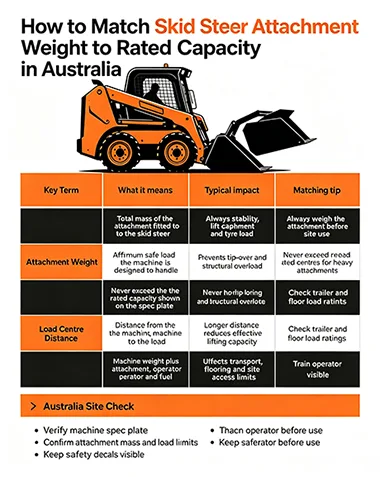
Choosing a skid steer attachment is not only about finding the right working width, hydraulic flow or attachment type. For Australian contractors, one of the most important questions is also whether the carrier can safely handle the attachment's weight and the loads created during operation.
A forestry mulcher, cold planer, pick-up broom or other specialised attachment can add substantial weight to the front of a skid steer. That weight affects the machine's lifting performance, stability, available operating capacity and the way it behaves when working on slopes, uneven ground or hard surfaces.
This is why attachment selection should start with the complete machine-and-attachment combination rather than the attachment specification alone.
Sibom Industry supplies skid steer loaders, compact track loaders and attachments for construction, landscaping, agriculture, municipal maintenance and material handling applications across Australia. Its published machine and attachment specifications provide useful examples of why weight, rated load, tipping load, hydraulic requirements and application conditions need to be considered together.
Why Attachment Weight Matters
A skid steer loader does not carry an attachment at the centre of the machine. The attachment is mounted at the front, which changes the load distribution and the leverage acting on the loader arms.
A heavier attachment can therefore affect more than the machine's ability to lift a load.
It can influence:
Available lifting capacity
Front-end stability
Tipping behaviour
Loader arm and coupler loading
Transport requirements
Manoeuvrability
Hydraulic attachment performance
Productivity on slopes or uneven ground
Wear on tyres, tracks and structural components
The important point is that attachment weight should not simply be subtracted from the loader's rated load to calculate a safe payload.
Rated operating capacity is a machine specification established under defined test and operating conditions. Actual safe capacity depends on the machine configuration, attachment, load centre, ground conditions, ballast, operating position and the manufacturer's operating requirements.
For this reason, an attachment that appears to be below a machine's published rated load may still require a closer compatibility assessment.
Rated Operating Capacity vs Tipping Load
Two specifications are particularly important when evaluating a skid steer:
Rated Operating Capacity
Rated operating capacity indicates the machine's rated working load under the manufacturer's defined conditions.
It is one of the first specifications contractors should review when comparing loaders for material handling and attachment work.
However, it should not be treated as a simple maximum payload figure for every attachment configuration.
The attachment itself contributes to the working load, and the location of the load relative to the machine changes the forces acting on the loader.
Tipping Load
Tipping load is a different specification.
It indicates the load at which the machine reaches a defined tipping condition under the relevant test configuration. It is not the recommended working load for routine operation.
For example, Sibom's published TR2200B specifications list a rated load of 2,425 lb and a tipping load of 4,850 lb. The TR2850B is listed with a rated load of 2,866 lb and a tipping load of 5,732 lb.
These numbers illustrate why buyers should not use tipping load as their normal operating target.
The correct approach is to work within the manufacturer's rated operating limits and account for the attachment and actual working conditions.
Attachment Weight Can Vary Significantly
Not all skid steer attachments place the same demand on a carrier.
A small broom and a large forestry mulcher may both connect to a skid steer quick hitch, but their weight, hydraulic demand and operating forces can be very different.
Sibom's published attachment specifications provide a useful example.
Its pick-up broom range includes models with published weights from approximately 397 lb for the smallest configuration to about 1,191 lb for the largest listed configuration.
By comparison, the Sibom 0513 Series forestry mulcher is significantly heavier. The published SDM60, SDM72 and SDM84 models weigh approximately 2,172 lb, 2,480 lb and 2,721 lb respectively, including the mount.
That difference is large enough to change the carrier selection decision.
A machine that is well suited to a broom, bucket or fork application may not automatically be the right carrier for a heavy forestry mulcher.
A Simple Attachment Sizing Example
Consider a contractor comparing two types of work.
Example 1: Site Cleanup
A contractor needs a pick-up broom for construction-site cleanup.
The Sibom pick-up broom range includes working widths from approximately 60 to 84 inches, with published model weights increasing with attachment size.
The contractor should consider:
Machine rated load
Attachment weight
Hydraulic flow
Working width
Surface conditions
Typical debris volume
Coupler compatibility
If the machine is relatively compact, choosing the widest broom simply because it covers more ground may not be the most productive decision.
A narrower attachment may provide better manoeuvrability and a more appropriate weight-to-machine relationship.
Example 2: Vegetation Clearing
Forestry mulching creates a different requirement.
Sibom's SDM60, SDM72 and SDM84 forestry mulchers weigh approximately 2,172–2,721 lb and require a host lifting capacity listed as greater than one tonne.
The same attachment range also requires approximately 110–135 L/min of hydraulic flow and up to about 3,046 psi pressure.
This means the buyer must evaluate several conditions simultaneously:
Can the machine carry the attachment?
Does it have sufficient rated operating capacity?
Is the machine stable with the attachment installed?
Does the auxiliary hydraulic system provide the required flow?
Is the hydraulic cooling system appropriate for continuous operation?
Is the carrier suitable for the vegetation and terrain?
Is the selected working width appropriate for the machine?
This is very different from choosing a general-purpose bucket.
Do Not Choose an Attachment by Weight Alone
Attachment weight is important, but it is only one part of the selection process.
A lighter attachment is not automatically better.
For example, an attachment may be relatively light but still require high hydraulic flow. A cold planer is a good example.
Sibom's 0206 Series cold planer range includes models with published weights of approximately 1,874 to 2,535 lb, depending on configuration.
The hydraulic requirement is also significant, with model-dependent flow requirements ranging from approximately 80 to 200 L/min.
Therefore, a contractor evaluating a cold planer must consider both:
Mechanical capacity + Hydraulic capacity
A carrier that can physically lift the planer may still be unsuitable if its auxiliary hydraulic system cannot provide the required flow and pressure.
Load Centre Is Just as Important as Attachment Weight
One of the easiest mistakes in attachment selection is looking only at kilograms or pounds.
Where the load is positioned also matters.
A load held further forward creates greater leverage than the same load held closer to the loader arms.
This becomes particularly important with:
Pallet forks
Grapples
Long buckets
Bale handling attachments
Material handling frames
Heavy hydraulic attachments
Loads that extend significantly beyond the attachment
For example, a pallet fork may weigh less than a large bucket, but the actual payload may be positioned much further forward.
The resulting machine behaviour cannot be evaluated from attachment weight alone.
When selecting material-handling attachments, buyers should therefore consider:
Attachment weight
Maximum rated load
Load centre
Load dimensions
Lift height
Ground conditions
Machine configuration
The machine manufacturer's capacity chart should remain the final reference for safe operating limits.
Attachment Width Also Affects Machine Selection
Wider does not always mean more productive.
A wider attachment can cover more ground per pass, but it can also:
Increase attachment weight
Increase the working envelope
Reduce manoeuvrability in confined areas
Change the machine's balance
Require a larger carrier
Increase transport dimensions
This is particularly relevant for Australian contractors working across mixed job sites.
A landscaper working between residential properties may value compact dimensions and manoeuvrability more than maximum attachment width.
A council maintaining large hardstands may benefit from a wider sweeper.
A forestry contractor may select a wider mulcher for production work, but only if the carrier has sufficient hydraulic and lifting capacity.
The correct width is therefore the width that matches both the job and the machine.
Match the Attachment to the Carrier, Not the Other Way Around
When purchasing an attachment for an existing skid steer, start with the carrier's specifications.
Collect the following information:
| Machine Information | Why It Matters |
|---|---|
| Machine make and model | Establishes the carrier configuration |
| Rated operating capacity | Determines the machine's rated working capability |
| Tipping load | Helps evaluate stability characteristics |
| Operating weight | Important for transport and site planning |
| Auxiliary hydraulic flow | Determines hydraulic attachment compatibility |
| Auxiliary hydraulic pressure | Must remain within attachment limits |
| Coupler type | Determines physical fitment |
| Electrical connections | Required for some hydraulic attachments |
| Case drain availability | Important for some hydraulic motors |
| Manufacturer capacity chart | Provides the final operating reference |
Once this information is available, the attachment can be evaluated against the actual carrier rather than against a generic skid steer category.
A Practical Australian Attachment Selection Checklist
Before ordering a skid steer attachment, Australian buyers should work through the following checklist.
1. Confirm the Machine Model
Do not specify an attachment using only the machine brand.
A manufacturer may offer several machines with substantially different operating capacities and hydraulic configurations.
Provide the exact model and, where relevant, the machine configuration.
2. Confirm Rated Operating Capacity
Check the machine's rated operating capacity using the manufacturer's published specifications.
Do not use tipping load as a substitute for rated operating capacity.
3. Record the Attachment Weight
Obtain the actual weight of the selected attachment configuration.
This is particularly important when comparing different attachment widths or models.
4. Check Hydraulic Flow and Pressure
For hydraulic attachments, compare the machine's auxiliary hydraulic output with the attachment's published operating range.
This is essential for tools such as:
Forestry mulchers
Cold planers
Sweepers
Trenchers
Breakers
Augers
Hydraulic saws
Sibom's published product data shows that hydraulic requirements can vary substantially between attachment types.
5. Check the Coupler
Confirm the actual mounting system rather than assuming that two machines use the same attachment interface.
Sibom's compatibility guidance recommends checking the mounting dimensions, pin centres, pin diameter, hanger width, wedge geometry and locking arrangement where relevant.
Physical connection alone does not guarantee a safe or correct fit.
6. Consider the Working Environment
Australian conditions vary considerably.
A machine working on:
Hardstand
Asphalt
Wet ground
Mud
Uneven rural terrain
Slopes
Construction sites
Bushland
may require different carrier and attachment combinations.
Ground conditions can affect stability, traction and practical working capacity.
7. Consider the Complete Working Combination
Do not assess the attachment in isolation.
The final configuration should be considered as:
Machine + coupler + attachment + payload + working conditions
This is particularly important for heavy attachments and material-handling applications.
When a Larger Attachment Is Not the Better Choice
Contractors sometimes assume that a larger attachment will automatically increase productivity.
That is only true when the carrier can operate it effectively.
For example, a wider attachment may require:
Greater lifting capacity
Greater hydraulic flow
More machine stability
More transport space
Greater manoeuvring clearance
If the carrier spends more time operating cautiously, struggling with hydraulic demand or carrying an attachment that is oversized for the job, theoretical working width does not translate into higher productivity.
The better approach is to select the attachment that the carrier can operate comfortably within its intended working limits.
Building a Multi-Attachment Skid Steer Fleet
Fleet managers should also think beyond a single attachment purchase.
If one skid steer is expected to operate:
A general-purpose bucket
Pallet forks
A grapple
A broom
A trencher
A mulcher
then the machine should be selected around the attachment combination rather than around one tool.
Sibom's compact loader range includes machines with standard and optional high-flow hydraulic configurations, while its attachment range covers construction, landscaping, municipal and material-handling applications.
This makes it useful to create an attachment matrix before purchasing.
| Attachment | Main Check |
|---|---|
| Bucket | Rated load, capacity, coupler |
| Pallet forks | Rated load, load centre, fork capacity |
| Grapple | Rated load, hydraulic pressure, jaw configuration |
| Pick-up broom | Attachment weight, flow, working width |
| Trencher | Flow, pressure, trench dimensions |
| Forestry mulcher | Attachment weight, high-flow hydraulics, carrier capacity |
| Cold planer | Attachment weight, high-flow hydraulics, milling width |
This approach helps fleet managers avoid buying a carrier that is excellent for one attachment but unsuitable for the rest of the fleet.
What Information Should You Send an Attachment Supplier?
A good attachment enquiry does not need to be complicated.
For an accurate compatibility review, provide:
Machine brand:
Machine model:
Rated operating capacity:
Auxiliary hydraulic flow:
Auxiliary hydraulic pressure:
Coupler type:
Attachment required:
Main application:
Typical working conditions:
Quantity required:
Location in Australia:
For example:
Machine: compact track loader
Attachment: forestry mulcher
Application: fence-line clearing and vegetation reduction
Hydraulic system: high flow
Preferred working width: 72 in
Coupler: universal skid steer
Location: Victoria
Sibom's Australian contact team can then review the machine and attachment requirements before quoting.
Why Attachment Compatibility Should Be Confirmed Before Freight
A fitment problem discovered after delivery can create unnecessary downtime and freight costs.
Before an attachment is ordered, confirm:
Mounting interface
Hydraulic flow
Hydraulic pressure
Hose connections
Case drain requirements
Electrical connections
Attachment weight
Machine capacity
Intended application
Sibom specifically promotes fitment checks before dispatch and asks customers to provide machine details when requesting compatibility confirmation.
For Australian contractors, this is particularly useful when purchasing equipment from overseas or when one attachment needs to work across a mixed fleet.
Frequently Asked Questions
How much attachment weight can a skid steer lift?
There is no single weight that applies to every skid steer. The answer depends on the machine's rated operating capacity, attachment configuration, load centre, hydraulic system and operating conditions. Always refer to the manufacturer's capacity information and confirm the complete machine-and-attachment combination.
Should I subtract attachment weight from rated operating capacity?
Not as a simple calculation. Rated operating capacity is established under defined test conditions and does not represent a universal payload allowance for every attachment configuration. Attachment weight, load centre and operating conditions must also be considered.
Is tipping load the same as lifting capacity?
No. Tipping load and rated operating capacity are different specifications. Tipping load should not be treated as the normal working load limit.
Does a heavier attachment always require a larger skid steer?
Not necessarily, but heavier attachments require closer evaluation of carrier capacity and stability. Hydraulic requirements and application forces must also be considered.
Does attachment width affect machine capacity?
It can. A wider attachment may weigh more and can change the working envelope and machine behaviour. Width should therefore be matched to both the application and carrier.
What is more important: attachment weight or hydraulic flow?
Both can be critical, depending on the attachment. A heavy non-powered attachment may primarily challenge lifting capacity, while a relatively manageable hydraulic attachment can still require substantial auxiliary flow.
What information should I provide before ordering an attachment?
Provide the machine make and model, rated operating capacity, hydraulic flow and pressure, coupler type, intended attachment, application and working environment. This allows the supplier to assess compatibility more accurately.
Can Sibom confirm whether an attachment will fit my skid steer?
Yes. Sibom states that customers can provide their machine brand, model, coupler and hydraulic information for a compatibility check before ordering.
Final Takeaway
Choosing the right skid steer attachment is not simply a matter of matching the attachment to the machine's brand or selecting the largest model that fits the coupler.
A reliable selection process considers:
Machine capacity → Attachment weight → Load centre → Hydraulic requirements → Coupler compatibility → Working environment → Actual application
Sibom's published product range demonstrates why this approach matters. Its pick-up broom configurations are substantially lighter than its forestry mulchers, while cold planers introduce another combination of attachment weight and high-flow hydraulic requirements.
For Australian contractors, the best attachment is therefore not necessarily the largest, widest or most powerful option. It is the attachment that the carrier can operate effectively within its intended limits while delivering the required productivity on the actual job.
Before ordering, provide the exact machine model, rated capacity, hydraulic specifications, coupler type and application. Sibom can then review the combination and confirm the appropriate attachment configuration before the order is finalised.