


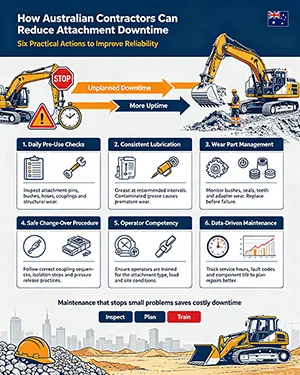
For Australian contractors, equipment productivity is measured by more than machine power. How quickly a machine can be prepared for the next task, how reliably its attachment performs and how easily problems can be identified can all affect the cost of a job.
A skid steer loader, compact track loader or wheel loader can perform a wide range of tasks when paired with the appropriate attachment. However, incorrect attachment selection, poor machine matching and inadequate maintenance planning can turn a versatile machine into an unexpected source of downtime.
For construction companies, landscaping contractors, farmers, municipal operators and fleet managers, reducing attachment downtime starts before the attachment arrives on site.
The objective is not simply to buy an attachment that physically fits the machine. The attachment needs to match the carrier, hydraulic system, application and working environment.
Why Attachment Downtime Happens
Attachment downtime can have several causes, and the underlying problem is not always immediately obvious.
Common issues include:
Incorrect machine-to-attachment matching
Hydraulic flow or pressure incompatibility
Incorrect coupler or mounting configuration
Using an attachment outside its intended application
Excessive wear on working components
Poor hydraulic hose and connection maintenance
Inadequate cleaning or storage
Operator error or unsuitable operating techniques
For a single-machine contractor, an attachment problem may delay one job. For a fleet operator, the consequences can be considerably greater if equipment is allocated across several projects.
This is why attachment selection should be treated as part of equipment planning rather than as a separate purchasing decision.
Start with the Carrier Machine
Before choosing an attachment, establish exactly what the carrier machine can support.
The relevant information may include:
Machine make and model
Operating capacity
Auxiliary hydraulic specifications
Coupler type
Available attachment width
Machine dimensions and access limitations
Intended working environment
A common mistake is to select an attachment based primarily on its physical dimensions.
Physical fitment is only one part of compatibility.
An attachment can connect mechanically while still being unsuitable for the machine's hydraulic system, operating capacity or intended application.
For this reason, contractors should confirm compatibility before placing an order rather than relying on assumptions based on machine size alone.
For more information, see the Sibom guide to Attachment Coupler Compatibilit.
Hydraulic Compatibility Can Affect Productivity
Hydraulic requirements become particularly important when using powered attachments.
Depending on the attachment, contractors may need to consider:
Auxiliary hydraulic flow
Hydraulic pressure
Continuous versus intermittent hydraulic operation
Hose and coupling configuration
Return-line requirements
Machine auxiliary hydraulic options
High-flow and standard-flow systems are not interchangeable simply because an attachment can be physically connected to the carrier.
Attachments such as mulchers, cold planers, hydraulic breakers and other powered equipment may have specific hydraulic requirements that need to be confirmed before purchase.
Sibom's guide on High Flow vs Standard Flow Skid Steer Attachmentsprovides further information on this consideration.
The key point for contractors is simple: do not select a hydraulic attachment based only on machine size or appearance. Confirm the hydraulic requirements against the actual machine specifications.
Match the Attachment to the Actual Job
The correct attachment depends on what the machine needs to accomplish.
A landscaping contractor preparing residential sites may prioritise compact dimensions, manoeuvrability and fast attachment changes. A rural operator clearing vegetation may have very different requirements.
Similarly, municipal contractors may need equipment that can move between different tasks throughout the working week.
Construction
Construction applications may place greater emphasis on:
Material handling
Site preparation
Groundwork
Debris removal
Site cleanup
Attachment versatility
Landscaping
Landscaping contractors may need to consider:
Working width
Access to confined areas
Ground disturbance
Material handling
Frequency of attachment changes
Agriculture
Farm operators may need to consider:
Seasonal utilisation
Ground conditions
Material type
Storage requirements
The ability to use one carrier machine for multiple tasks
Municipal Work
Municipal applications can involve repeated operations across different locations.
Important considerations may include:
Attachment changeover time
Operator familiarity
Transport between sites
Maintenance access
Consistent operating procedures
The same attachment is therefore not necessarily the right choice for every customer, even when the carrier machine is similar.
Attachment Size Should Match the Machine and Application
Bigger is not automatically better.
An attachment that is too large for the machine may negatively affect handling, visibility, operating capacity or overall efficiency. Conversely, an attachment that is too small may increase the number of passes required and reduce productivity.
Attachment sizing should therefore be considered together with:
Carrier capacity
Working width
Material being handled
Site conditions
Required production rate
Transport limitations
Frequency of use
For customers comparing different attachment options, the Skid Steer Attachment Weight Guid is a useful starting point.
Where a manufacturer's published information does not provide enough detail for a particular machine configuration, contractors should confirm the required specifications with the attachment supplier before purchase.
Preventive Maintenance Is Part of Productivity
Maintenance is often viewed as a cost, but unplanned downtime can be considerably more disruptive than scheduled inspection and servicing.
A practical attachment maintenance routine should include regular inspection of the components most exposed to wear, impact and contamination.
Before Operation
Operators should check:
Attachment mounting and locking points
Hydraulic hoses and connections
Visible structural damage
Loose fasteners
Working components
Safety-related components
During Regular Maintenance
Depending on the attachment, inspection may include:
Wear components
Cutting edges
Teeth
Blades
Bearings
Greasing points
Hydraulic connections
Structural components
The exact maintenance requirements depend on the attachment type and operating conditions, so the manufacturer's maintenance instructions should always take priority.
After Heavy or Unusual Use
Attachments used in abrasive, high-impact or demanding conditions may require additional inspection.
Signs that deserve attention include:
Unusual vibration
Reduced operating performance
Hydraulic leaks
Abnormal noise
Loose components
Unexpected wear
Identifying these symptoms early can help prevent a minor maintenance issue from becoming a larger equipment problem.
Operator Technique Matters
The attachment is only one part of the operating system.
Operator technique can have a significant effect on attachment wear and productivity.
Operators should understand:
The intended application of the attachment
Machine and attachment operating limits
Correct attachment engagement
Appropriate operating techniques
Hydraulic operating requirements
Safe working procedures
Using an attachment for a task outside its intended application can place unnecessary stress on both the attachment and carrier machine.
Training does not need to be complicated. Operators should simply understand what the attachment is designed to do, what conditions require additional care and what warning signs should trigger an inspection.
Build Attachments into Fleet Planning
For companies operating several machines, attachments should be considered part of the overall fleet rather than individual accessories.
A well-planned attachment fleet can allow a smaller number of carrier machines to perform more tasks.
Fleet managers can assess each attachment according to:
| Consideration | Fleet Planning Question |
|---|---|
| Compatibility | Which machines can operate the attachment? |
| Hydraulic requirements | Does the machine provide the required hydraulic capability? |
| Utilisation | How frequently will the attachment be used? |
| Application | Which jobs is it actually intended for? |
| Maintenance | What inspections and wear components are required? |
| Changeover | How easily can operators move between tasks? |
| Storage | Can the attachment be stored safely between projects? |
This approach can help companies avoid purchasing attachments that have limited practical use within the fleet.
It can also make it easier to identify which attachments should be prioritised for investment.
Consider the Total Cost of Ownership
Purchase price is only one part of the cost of an attachment.
A more useful evaluation considers the attachment's expected contribution to the operation.
Relevant factors may include:
Purchase cost
Machine compatibility
Installation requirements
Maintenance requirements
Wear component replacement
Operator training
Transport and storage
Expected utilisation
Downtime risk
For example, an attachment that is inexpensive to purchase but difficult to match with existing machines may not provide the expected value.
Similarly, an attachment that is rarely used may require a different purchasing strategy from an attachment that operates every day.
The right decision depends on the customer's fleet, applications and operating conditions.
Work with the Supplier Before Ordering
For specialised hydraulic attachments or non-standard applications, supplier communication should happen before the purchase decision is finalised.
Providing detailed machine information allows the supplier to assess the intended configuration more accurately.
Useful information can include:
Machine manufacturer
Machine model
Coupler configuration
Auxiliary hydraulic specifications
Intended application
Working environment
Required attachment type
Any specific dimensions or operating requirements
Sibom supplies attachment solutions for applications across construction, agriculture, landscaping, forestry and other industries, with support for OEM and custom manufacturing requirements.
Where a specific technical specification is not published on the product page, customers should confirm the requirement directly with Sibom rather than relying on an assumed specification.
A Practical Pre-Purchase Checklist
Before ordering an attachment, Australian contractors can work through the following checklist:
Identify the exact carrier machine.
Confirm the coupler and mounting configuration.
Check hydraulic flow and pressure requirements where applicable.
Confirm the attachment's intended application.
Assess the required working width and attachment size.
Consider operating conditions and material type.
Review maintenance and wear requirements.
Consider how frequently the attachment will be used.
Confirm any application-specific technical requirements with the supplier.
Request a quotation based on the actual machine and application.
This process can reduce the risk of buying an attachment that looks suitable on paper but performs poorly in the real operating environment.
FAQ
How can Australian contractors reduce attachment downtime?
Start with correct machine compatibility, confirm hydraulic and coupler requirements, select the attachment according to the actual application and maintain it according to the manufacturer's recommendations.
Does an attachment need to match the machine's hydraulic system?
Powered hydraulic attachments need to be matched to the carrier's hydraulic capabilities. The required specifications vary according to the attachment, so contractors should confirm the requirements before purchase.
Is a heavier attachment always better?
No. Attachment weight needs to be considered alongside carrier capacity, application, working conditions and handling requirements.
How often should attachments be inspected?
Inspection frequency depends on the attachment type, operating conditions and level of use. Operators should perform appropriate pre-operation checks and follow the manufacturer's maintenance recommendations.
What information should I provide when requesting an attachment quote?
Providing the machine make and model, coupler configuration, hydraulic specifications where applicable, intended application and operating environment can help the supplier determine the appropriate attachment configuration.
Conclusion
Reducing attachment downtime starts well before a machine reaches the job site.
For Australian contractors and fleet managers, the most important decisions are often the ones made during attachment selection: whether the attachment matches the carrier, whether the hydraulic system is suitable, whether the size is appropriate and whether the attachment is designed for the actual application.
Once the attachment is in operation, regular inspection, appropriate maintenance and correct operator technique help protect productivity.
The goal is not simply to find an attachment that fits.
The goal is to build a machine-and-attachment combination that works efficiently, safely and reliably within the conditions of the job.
For contractors, equipment dealers, farmers, landscaping businesses and municipal operators considering a new attachment, providing complete machine and application information before purchase is one of the simplest ways to make the selection process more accurate.
Request a Quote from Sibomto discuss your machine, application and attachment requirements.