


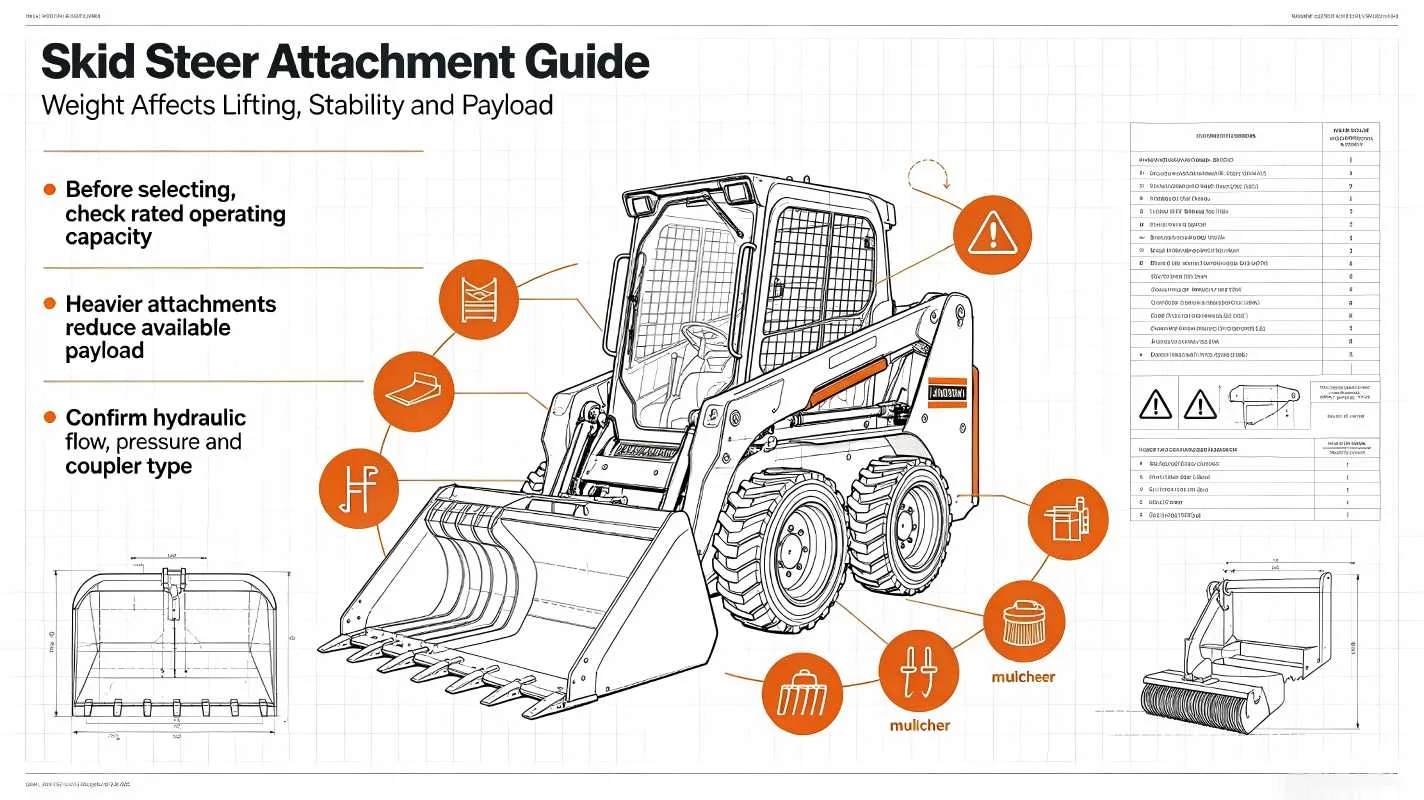
Choosing a skid steer attachment is not only about hydraulic flow, working width or mounting compatibility. Attachment weight can have a major effect on lifting performance, stability, transport and the type of work your machine can safely perform.
For Australian contractors, landscapers, farmers, municipal operators and equipment dealers, the right attachment should be matched to the machine as a complete working system, rather than selected by attachment size alone.
Why Attachment Weight Matters
Every attachment adds weight to the front of the machine before any material is picked up.
A bucket, grapple, pallet fork, sweeper or other attachment therefore affects the available lifting capacity of the loader. A heavier attachment can reduce the amount of payload available for the actual material being handled.
This becomes particularly important when working with:
Pallets and packaged materials
Soil, gravel and aggregate
Logs and vegetation
Full buckets
Heavy construction materials
Grapples and other hydraulic attachments
The machine's rated operating capacity should always be considered together with attachment weight, load centre and working conditions.
Do Not Compare Attachment Weight by Itself
A common purchasing mistake is to ask whether an attachment is "heavy duty" without considering what machine will operate it.
A heavier attachment is not automatically better. It may provide additional structural strength for a demanding application, but it also places more weight on the loader.
When choosing an attachment, consider:
Machine rated operating capacity
Attachment weight
Intended material
Material density
Attachment capacity
Load centre
Ground conditions
Frequency of operation
The same principle applies to buckets, forks, grapples, sweepers and forestry attachments.
Match Attachment Weight to the Machine
Before ordering an attachment, collect the actual specifications of your loader.
| Machine Information | Why It Matters |
|---|---|
| Rated operating capacity | Determines the machine's lifting capability |
| Operating weight | Helps evaluate stability and transport |
| Hydraulic flow | Required for powered attachments |
| Hydraulic pressure | Must match attachment requirements |
| Coupler type | Determines mechanical compatibility |
| Attachment weight | Reduces available payload |
| Load centre | Affects practical lifting performance |
Sibom offers attachments for different machine platforms and applications. However, compatibility should still be confirmed for the specific loader model before ordering.
Attachment Type Makes a Difference
Buckets
Buckets are commonly used for soil, gravel, sand, mulch and general material handling.
When selecting a bucket, do not simply choose the largest available capacity. The weight of the bucket and the density of the material must be considered together.
A large bucket filled with dense material can exceed the practical capacity of a compact loader even when the bucket physically fits the machine.
Pallet Forks
Fork frames may appear relatively simple, but their weight and load centre are important.
When carrying a pallet, the load is positioned forward of the loader arms. As the load centre increases, the effective lifting capability of the machine can decrease.
For contractors handling building materials, landscaping supplies or agricultural products, this should be considered before selecting a fork attachment.
Grapples
Grapples combine attachment weight with hydraulic functions.
A heavier grapple may be useful for demanding material handling or vegetation work, but the machine must still have sufficient capacity for the grapple plus the material being carried.
When selecting a grapple, confirm the carrier's lifting capacity, hydraulic requirements, mounting configuration and intended application.
Sweepers
Sweepers are another example where attachment size should be matched to the machine.
A wider sweeper can cover more ground per pass, but increased attachment size may also mean increased weight and hydraulic requirements.
When selecting a broom or sweeper, contractors should consider hydraulic flow, loader capability, working width, surface conditions and mounting configuration.
Forestry and Mulching Attachments
Forestry mulchers can place significantly different demands on a skid steer because they combine attachment weight with continuous hydraulic power requirements.
For this type of work, buyers should consider the machine's rated capacity, attachment weight, hydraulic flow and intended vegetation conditions together rather than selecting a mulcher based only on working width.
A Simple Pre-Purchase Checklist
Before requesting a quote, Australian buyers should prepare the following information.
Machine Information
Machine brand
Machine model
Serial number
Wheeled skid steer or compact track loader
Rated operating capacity
Auxiliary hydraulic flow and pressure
Attachment Information
Intended attachment type
Required working width
Expected material
Typical load
Required hydraulic functions
Existing coupler or mounting system
Application Information
Construction
Landscaping
Agriculture
Municipal maintenance
Material handling
Forestry or vegetation management
This information allows the attachment to be assessed as part of the complete machine package rather than simply checking whether the mounting plate fits.
What About Transport?
Attachment weight also matters before the machine reaches the jobsite.
Contractors transporting a loader together with several attachments should consider the combined equipment weight, trailer capacity and applicable Australian transport requirements.
A machine may be suitable for operating an attachment but still require a different transport arrangement when several heavy attachments are moved together.
Planning transport at the purchasing stage can help prevent unexpected logistics problems later.
Weight Is Only One Part of Compatibility
Attachment weight should never be considered independently.
A complete compatibility check should include:
Mechanical fit → Hydraulic compatibility → Attachment weight → Rated capacity → Application → Transport
When purchasing an attachment, provide the machine brand, model, serial number, coupler information and relevant mounting details so compatibility can be properly assessed.
Frequently Asked Questions
1. How do I know if an attachment is too heavy for my skid steer?
Compare the attachment's actual weight with your skid steer's rated operating capacity, while also considering the weight and position of the material being carried. The attachment should not be evaluated by weight alone.
2. Does attachment weight reduce the amount of material I can carry?
Yes. The attachment itself contributes to the total load carried by the machine. A heavier attachment can therefore reduce the practical payload available for soil, gravel, pallets, vegetation or other materials.
3. Is a heavier skid steer attachment always stronger?
No. Attachment weight should be appropriate for the intended application and carrier machine. A heavier design may be useful for certain demanding applications, but unnecessary weight can reduce lifting performance and manoeuvrability.
4. Should I choose an attachment based on my skid steer's maximum lifting capacity?
Not by itself. You should also consider attachment weight, load centre, material density, hydraulic requirements, ground conditions and the way the attachment will actually be used.
5. Does attachment width affect machine performance?
Yes. A wider attachment can increase productivity by covering more area per pass, but it may also increase attachment weight and hydraulic demand. Working width should therefore be matched to the machine and application.
6. How does load centre affect skid steer attachment selection?
The further a load is positioned from the machine, the greater its effect on lifting performance and stability. This is particularly important when using pallet forks, grapples and other attachments that carry loads forward of the loader arms.
7. Do hydraulic attachments require more than just the correct weight?
Yes. Powered attachments also require compatible auxiliary hydraulic flow, pressure, connections and control functions. Mechanical compatibility alone does not guarantee that an attachment will operate correctly.
8. Can one attachment be used on different skid steer loaders?
Potentially, but compatibility must be checked for each machine. The mounting system, hydraulic requirements, attachment weight and machine capacity should all be confirmed before moving an attachment between machines.
9. What information should I provide when buying an attachment from Sibom?
Provide the machine make, model and serial number, rated operating capacity, auxiliary hydraulic specifications, coupler type and intended application. If available, photos of the machine's mounting interface can also help with compatibility checks.
10. Should I ask Sibom to confirm attachment compatibility before ordering?
Yes. When machine specifications or attachment requirements are uncertain, confirming compatibility before purchase can help avoid problems with mounting, hydraulic operation, lifting capacity or application performance.
11. Does attachment weight matter when transporting equipment?
Yes. The combined weight of the loader, attachment and other equipment can affect trailer selection and transport planning. Contractors should check the applicable Australian transport and load requirements before moving equipment between jobsites.
12. What is the most important factor when selecting a skid steer attachment?
There is no single factor. The best selection considers machine capacity, attachment weight, hydraulic compatibility, mounting system, working dimensions and the intended application together.
Final Takeaway
The right skid steer attachment is not necessarily the largest, widest or heaviest model.
For Australian contractors, a better approach is to match attachment weight, machine capacity, hydraulic requirements, mounting system and application as one complete package.
Before ordering, provide Sibom with your machine details and intended application so the appropriate attachment configuration can be confirmed.