


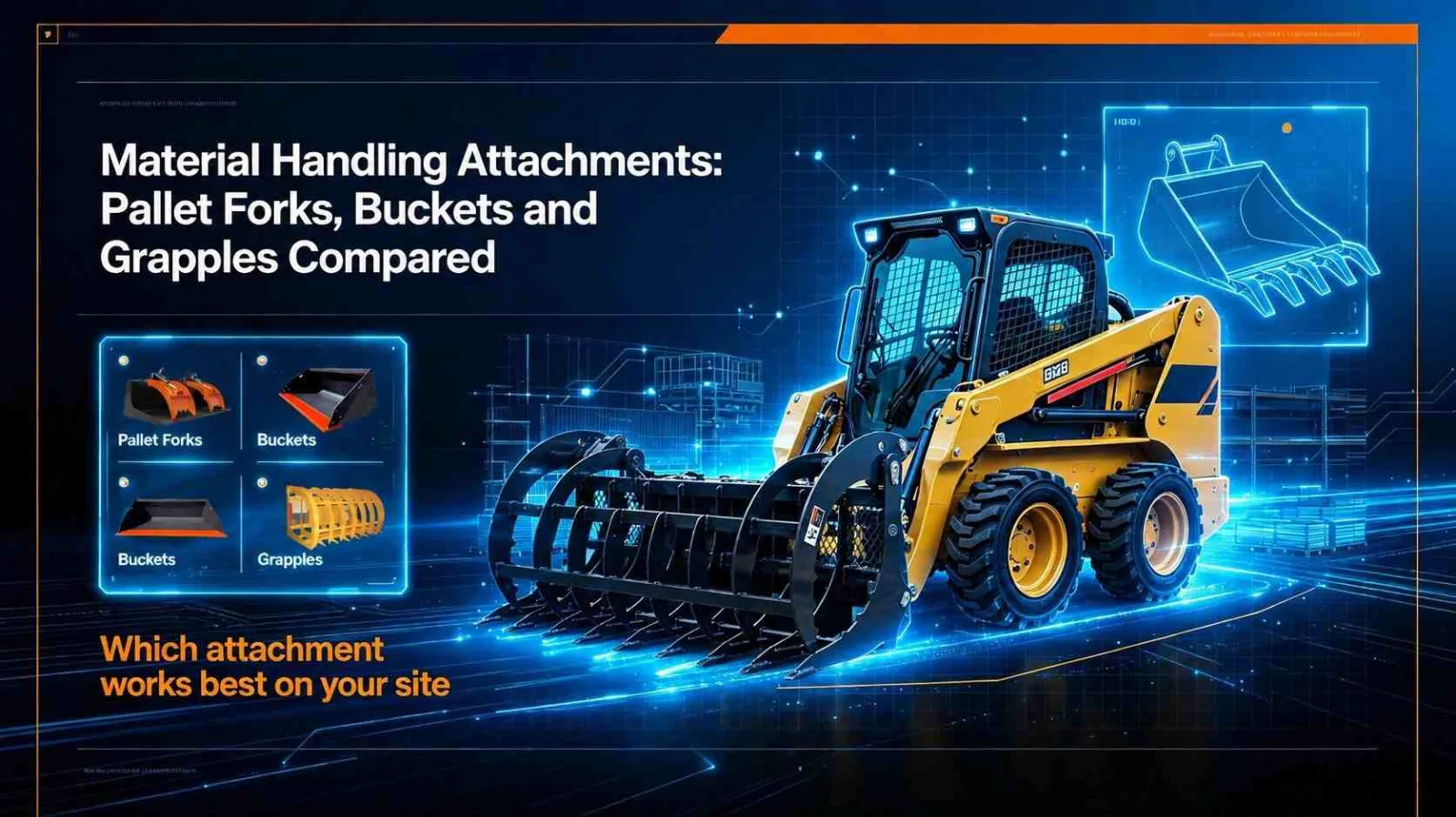
Material handling is one of the most common tasks performed by wheel loaders and skid steers on construction sites, in timber yards, at recycling facilities and across warehouse logistics operations. Choosing the right material handling attachments — pallet forks, buckets or grapples — directly affects load security, cycle time and operator safety.
This guide compares the three main material handling attachment categories, explains when each is the most efficient choice, and provides selection criteria for procurement teams and fleet managers.
Understanding Material Handling Requirements
Before comparing attachment types, define the handling task:
Load type — uniform (pallets, bales, blocks) or irregular (logs, scrap, brush, loose aggregate).
Load weight and dimensions — determines fork length, frame capacity and grapple jaw opening requirements.
Travel distance — longer travel distances favour stable, secure load retention over loading speed.
Loading and unloading height — affects machine capacity rating at the working lift height.
Surface conditions — firm yard surfaces vs uneven site ground affects machine stability during travel with load.
Pallet Forks: Best for Uniform, Palletised Loads
Pallet forks are the most efficient attachment for handling palletised goods, packaged building materials, bagged products and uniform stacked items. They provide stable, predictable load support and allow precise placement at height.
Key Specification Factors
Fork length — must support the full depth of the load. Standard forks range from 1,000 mm to 1,800 mm for loader applications.
Frame width — should match or exceed the typical pallet or load width for stability.
Rated capacity — frame and fork rating must exceed the heaviest routine load, including dynamic loading factors during travel.
Backrest — a load backrest prevents items from falling backward toward the operator during travel and stacking.
Best Applications
Pallet forks are the preferred choice for: building material yards (blocks, pavers, bagged cement), warehouse logistics, nursery and garden supply handling, and any operation where loads are consistently palletised or uniformly dimensioned.
Limitations
Forks are unsuitable for loose material, irregular loads and materials without a stable base. Attempting to handle loose aggregate or demolition debris with forks is inefficient and creates spillage and safety risks.
Buckets: Best for Loose and Bulk Materials
General-purpose and high-capacity buckets handle loose bulk material — sand, gravel, mulch, grain, recycled aggregate and mixed fill. Buckets are the default material handling tool where loads are not palletised or uniformly shaped.
Key Specification Factors
Bucket capacity — matched to material density and machine rated operating capacity.
Profile — general-purpose profiles for mixed material; high-capacity profiles for light, bulky material.
Cutting edge — standard edge for low-abrasion material; hardened or bolt-on edge for abrasive bulk products.
Spill guard — optional spill guard or raised top edge reduces material loss during travel.
Best Applications
Buckets are preferred for: aggregate stockpile management, bulk material loading to trucks and hoppers, mulch and compost handling, snow removal and any application involving loose, free-flowing material.
Limitations
Buckets are less efficient for palletised goods and provide less load security during travel over uneven ground compared to forks. Load spillage during travel is a common issue when buckets are used for materials that should be handled with forks or grapples.
Grapples: Best for Irregular and Loose Loads
Grapples provide positive mechanical retention for irregular, loose and oversized materials. The hydraulic jaw mechanism clamps the load during lifting and travel, preventing spillage and improving operator control.
Key Specification Factors
Jaw opening — must accommodate the maximum load dimension.
Tine spacing and configuration — close spacing for brush and small debris; wide spacing for logs and large objects.
Cylinder force — clamping force must be sufficient for the load weight and material compressibility.
Rotation — rotating grapples add placement precision for sorting and loading applications.
Best Applications
Grapples are preferred for: log and timber handling, demolition debris sorting, scrap metal and recycling operations, brush and vegetation clearing, and any application involving irregular or loose material that cannot be palletised.
Limitations
Grapples are heavier than forks or buckets, reducing available machine capacity. They require hydraulic power and are slower to cycle than forks for uniform palletised loads. Operating cost (hydraulic wear, pin and bushing maintenance) is higher than static attachments.
Side-by-Side Comparison
| Factor | Pallet Forks | Buckets | Grapples |
|---|---|---|---|
| Load type | Uniform, palletised | Loose, bulk | Irregular, loose |
| Load security during travel | High | Low–medium | High |
| Cycle speed | Fast | Fast | Medium |
| Hydraulic requirement | None | None | Required |
| Relative weight | Light | Medium | Heavy |
| Maintenance intensity | Low | Medium (edge wear) | High (pins, cylinders) |
| Best machine types | Loaders, skid steers | Loaders, skid steers | Loaders, skid steers, excavators |
Matching Attachments to Your Operation
Most material handling operations require more than one attachment type. Recommended configurations by sector:
Building Material Yards
Primary: pallet forks for packaged and palletised stock. Secondary: GP bucket for aggregate and sand. Consider a quick coupler for daily tool changes.
Timber and Forestry
Primary: log grapple or log forks. Secondary: GP bucket for chip and sawdust handling. Specify grapple jaw opening against maximum log diameter.
Recycling and Waste
Primary: sorting grapple. Secondary: heavy-duty bucket for bulk loading. Rotating grapples improve sorting efficiency at picking stations.
Construction Site Logistics
Primary: pallet forks for delivered materials. Secondary: GP bucket for fill and aggregate. Grapple for demolition debris if handling mixed waste on site.
View material handling attachments for wheel loaders and skid steers in the Sibom range.
Frequently Asked Questions
Should I use forks or a bucket for palletised building materials?
Pallet forks are significantly more efficient and safer for palletised materials. Buckets require awkward loading angles, provide poor load retention during travel and increase spillage risk.
What fork length do I need for standard pallets?
Standard Australian and international pallets (1,165 × 1,165 mm) are handled with forks of 1,200–1,400 mm effective length. Longer forks (1,600–1,800 mm) are required for oversized pallets or multiple pallet handling.
Can a grapple replace a bucket for all material handling tasks?
No. Grapples are optimised for irregular and loose material retention. They are slower and less efficient than buckets for free-flowing bulk material loading, and less precise than forks for palletised goods.
How do I calculate safe load capacity for material handling attachments?
Refer to the machine's rated operating capacity chart at the working lift height. Subtract attachment weight from the rated capacity to determine maximum payload. Do not exceed the attachment's own rated frame or fork capacity, whichever is lower.
What is the most versatile material handling setup for a mixed operation?
A hydraulic quick coupler with pallet forks (primary) and a GP bucket (secondary) covers the majority of material handling tasks on mixed construction and yard operations. Add a grapple if irregular load handling is a routine requirement.
Does Sibom supply material handling attachments for bulk orders?
Yes. Sibom manufactures pallet forks, buckets and grapples for wheel loaders and skid steers. Request a quote for standard or custom specifications. Review manufacturing capabilities for OEM and fleet supply programmes.
Next Steps
Material handling efficiency depends on matching the attachment type to the load characteristics — not using a single tool for all tasks. Define your primary load types, confirm machine capacity data and configure a core attachment kit that covers your routine handling requirements.
Contact Sibom Industry for material handling attachment specifications and fleet supply enquiries.