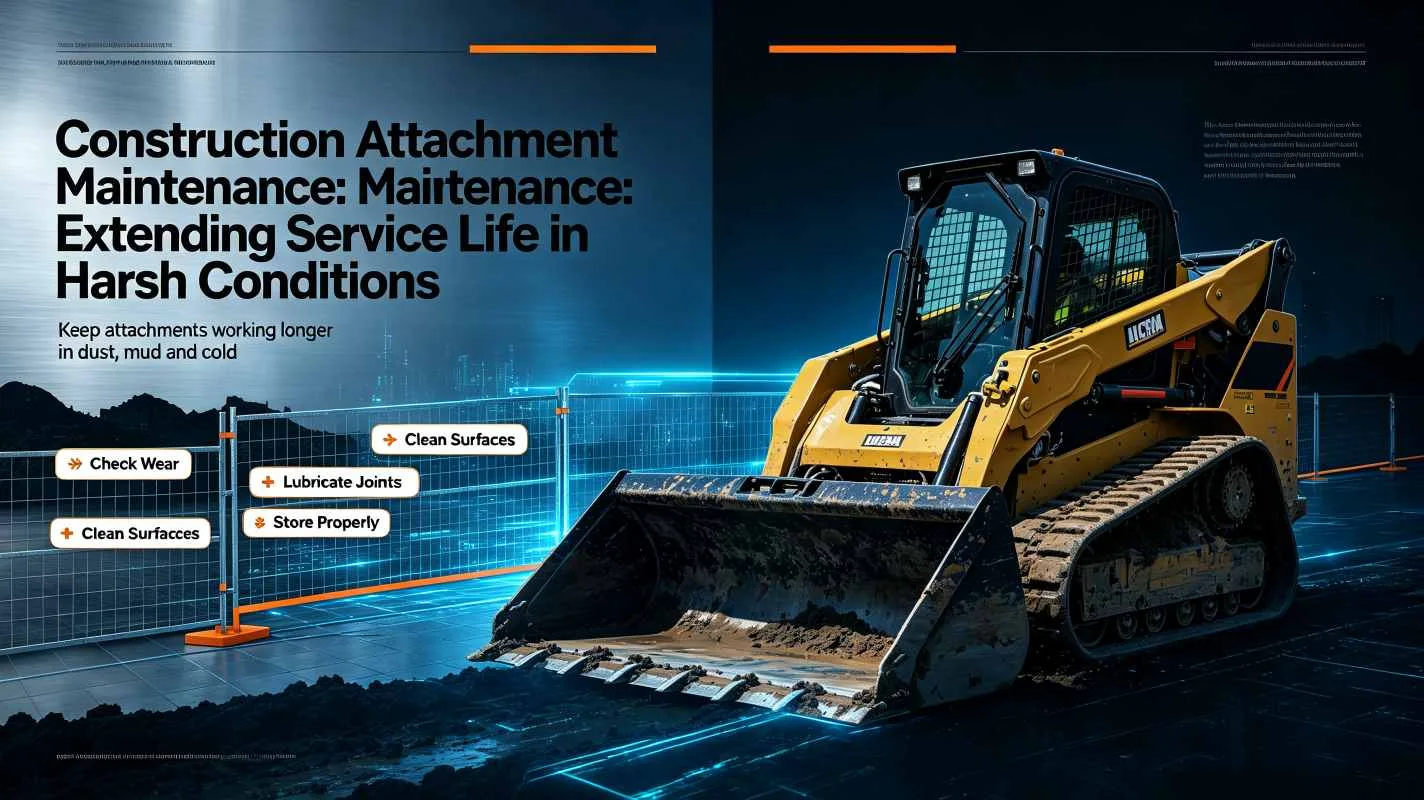
Construction attachments operate in some of the most demanding conditions in the equipment industry — abrasive materials, impact loading, continuous duty cycles and minimal downtime tolerance. A structured construction attachment maintenance programme extends service life, reduces unplanned downtime and lowers the total cost of ownership across your fleet.
This guide covers routine inspection procedures, wear component replacement schedules and best practices for maintaining buckets, forks, grapples and hydraulic tools on wheel loaders, skid steers and excavators.
Why Attachment Maintenance Is Often Overlooked
Machine engine, transmission and hydraulic system maintenance typically follow manufacturer-prescribed schedules. Attachments — which are subject to direct material contact, impact and abrasion — often receive less systematic attention until a failure occurs. This reactive approach is costly: a failed cutting edge mid-shift, a seized grapple pin or a cracked bucket lug can halt production and create safety hazards.
Treating attachments as maintained assets — with defined inspection intervals and wear part inventories — delivers measurable returns in reduced downtime and extended body life.
Daily Pre-Operation Inspection
A brief daily inspection before operation takes five to ten minutes and identifies problems before they escalate.
Mounting connection — check coupler locking mechanism engagement, pin condition and play in the mounting lugs. Any excessive movement warrants immediate investigation before operation.
Structural cracks — visually inspect weld zones, lug corners and high-stress areas for new cracks or crack propagation from previous repairs.
Cutting edge condition — check for excessive wear, missing segments or exposed adapter blocks on toothed buckets.
Grapple jaw and pin condition — check jaw alignment, pin play and cylinder rod condition on grapple attachments.
Hydraulic hoses and fittings — inspect for leaks, abrasion damage and fitting tightness on powered attachments.
Missing hardware — confirm all bolts, retainers and pin caps are in place and torqued.
Wear Components: Replacement Intervals and Signs
Cutting Edges and Bucket Teeth
Cutting edges and teeth are the highest-consumption wear items on bucket attachments. Replacement intervals depend on material abrasiveness and operating hours:
General soil and fill: 400–600 operating hours.
Sand and aggregate: 200–400 hours.
Blasted rock and demolition debris: 100–200 hours.
Replace edges when wear reduces digging or loading efficiency, when tooth adapters become exposed, or when edge thickness falls below the manufacturer's minimum specification. Running worn edges accelerates wear on the bucket shell and increases fuel consumption due to reduced penetration.
Grapple Pins and Bushings
Grapple hinge pins and bushings wear under cyclic loading and abrasive contamination. Inspect monthly for play and lubricate per manufacturer recommendations. Replace pins and bushings when radial play exceeds specification — continued operation with worn pins transfers load to the grapple frame and cylinder mounts, leading to structural cracking.
Wear Plates and Heel Blocks
Replaceable wear plates on bucket heels, side walls and floor sections protect the parent structure. Replace wear plates before they wear through to the base metal — once base plate is exposed, repair costs increase significantly. Keep a stock of wear plates matched to your active bucket fleet.
Hydraulic Components
Hydraulic cylinder rod seals, hose assemblies and motor seals on powered attachments require inspection for leaks at each service interval. Rod scoring from external contamination is a common cause of seal failure. Protect cylinder rods from abrasive material contact during operation and cleaning.
Scheduled Maintenance by Operating Hours
| Interval | Actions |
|---|---|
| Daily (pre-operation) | Mounting check, visual crack inspection, edge/teeth condition, hydraulic leak check |
| Every 250 hours | Grease all grease points (grapple pivots, coupler pivots), inspect pin and bushing play, check bolt torques on edge systems |
| Every 500 hours | Detailed weld inspection, cutting edge measurement, hydraulic hose condition assessment, coupler locking mechanism function test |
| Every 1,000 hours | Structural assessment by qualified inspector, coupler pin and bushing replacement assessment, full hydraulic system review on powered attachments |
Maintenance Practices for Harsh Operating Conditions
Abrasive Material Environments
Quarries, recycling yards and aggregate processing sites accelerate all wear rates. In these environments:
Use hardened or carbide-protected cutting edges where available.
Reduce inspection intervals to 50% of standard recommendations.
Maintain a higher stock of cutting edges, teeth and wear plates.
Consider heavy-duty attachment specifications for body components — not just wear parts.
For heavy-duty attachment specifications, see our guide on heavy duty construction attachments.
Corrosive Environments
Marine, waste handling and chemical exposure environments require additional corrosion protection. Wash attachments after exposure to corrosive materials, inspect paint and coating integrity regularly, and apply touch-up coating to exposed steel surfaces promptly.
High-Impact Applications
Demolition and rock handling subject attachments to impact loads beyond normal digging and loading forces. Inspect for structural cracks after each shift in these applications. Do not repair cracked structural weldments without engineering assessment — field welding of structural cracks without proper procedure can create brittle failure points.
Record Keeping and Fleet Management
Maintain an attachment register for each unit in your fleet:
Attachment type, serial number (if applicable) and machine pairing.
Installation date and total operating hours.
Cutting edge and wear part replacement history.
Structural inspection findings and repair records.
Coupler compatibility confirmation documentation.
Digital fleet management systems or simple spreadsheet registers both work. The objective is to move from reactive to planned maintenance based on actual wear data from your operating conditions.
Sourcing Wear Parts and Replacement Components
Wear part availability is a critical factor in attachment supplier selection. When evaluating suppliers — including for construction equipment attachments — confirm:
Availability of cutting edges, teeth, wear plates and pins for your attachment models.
Lead time for wear part delivery to your location.
Compatibility of wear parts across attachment production batches.
Pricing for wear parts relative to attachment purchase price (high wear part costs erode TCO advantages).
Establish a minimum stock level for high-consumption wear items based on your replacement frequency data. For fleet operators in remote locations across Australia and New Zealand, local wear part stock is particularly important given international shipping lead times.
Frequently Asked Questions
How often should I inspect attachment mounting pins and couplers?
Visually inspect daily before operation. Perform a detailed play and wear assessment every 250 operating hours. Replace pins and bushings when radial play exceeds the manufacturer's limit — typically 2–3 mm for loader coupler pins.
Can I flip cutting edges to extend their service life?
Reversible cutting edges can be flipped once to use the unworn side. Single-bevel edges cannot be reversed. After both sides are consumed, replace the edge assembly — do not continue operating with exposed adapter blocks or reduced edge section.
What causes cracks in bucket mounting lugs?
Common causes: overloading beyond rated capacity, impact loading from dropping loads onto the bucket, fatigue from cyclic loading at stress concentrations, and continued operation with worn or loose mounting pins. Cracked lugs require engineering assessment — do not return to service without qualified repair or replacement.
How do I maintain a hydraulic quick coupler?
Clean the coupler interface before attachment changes to prevent debris entering locking mechanisms. Grease pivot points at the recommended interval. Test the locking function daily. Inspect for worn locking components every 500 hours. A coupler that fails to lock securely is a critical safety hazard.
Should I repair or replace a heavily worn bucket?
Evaluate repair cost against replacement cost and remaining body life. Localised wear plate replacement and edge system renewal are cost-effective repairs. Structural cracking, severe base plate thinning or multiple lug repairs typically justify replacement rather than further repair investment.
Where can I source wear parts for Sibom attachments?
Contact Sibom Industry with your attachment model and wear part requirements. Confirm wear part availability and lead time at the point of initial attachment purchase to plan your maintenance inventory. Review Sibom after-sales support for fleet supply agreements.
Next Steps
Attachment maintenance is a fleet management discipline, not an occasional task. Implement a daily inspection routine, maintain wear part stock for your highest-consumption items, and track operating hours against replacement intervals based on your actual site conditions.
Contact Sibom Industry for wear part supply, attachment inspection guidance and replacement specifications.